
Shockwave Therapy vs Surgery: Heal Without the Scalpel or Solve It for Good?
For most patients with chronic tendon, heel, or soft-tissue pain, shockwave therapy is the smarter first choice—it’s non-invasive, requires no downtime, and resolves a large share of cases for a fraction of the cost—while surgery is the better option only when there’s structural damage, a full tear, or symptoms that haven’t responded to conservative care. In other words, start conservative and reserve the operating room for problems that genuinely need it. This guide breaks down how each option works, what it costs, the realistic recovery timelines, and exactly when each one wins—so San Diego patients can make a confident, informed decision rather than jumping straight to the most aggressive treatment.
Understanding Shockwave Therapy
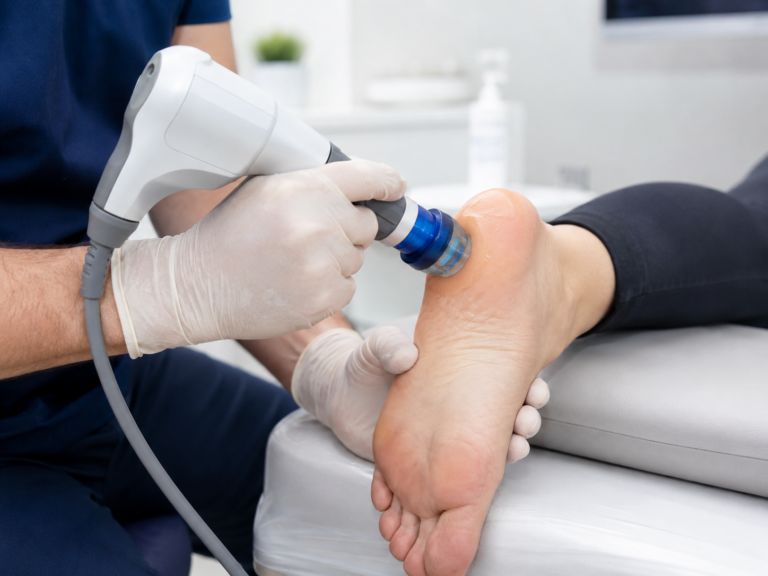
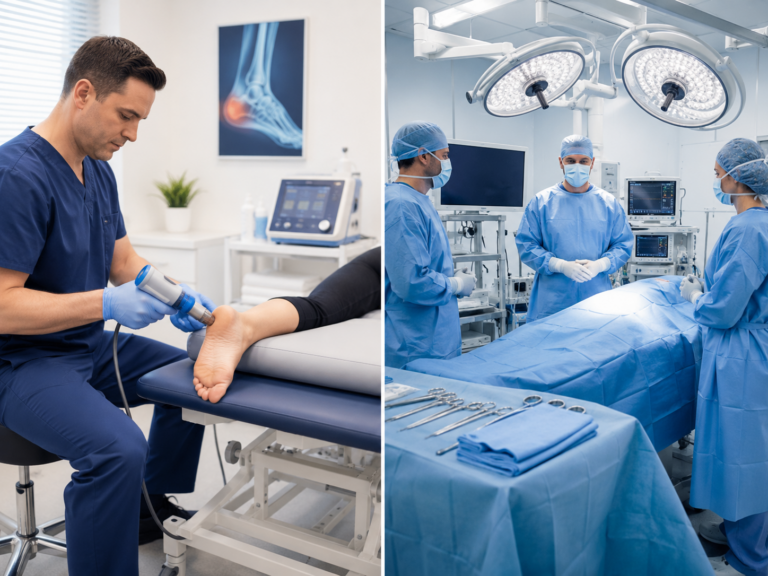
Shockwave therapy—clinically known as Extracorporeal Shockwave Therapy (ESWT)—is a non-invasive treatment that delivers acoustic pressure waves through the skin into injured tissue. These pulses trigger a controlled micro-inflammatory response that stimulates blood flow, breaks down calcified deposits, and accelerates the body’s natural healing cascade. Because nothing is cut, injected, or surgically altered, there’s no incision and no general anesthesia. You can learn more about the underlying mechanism on our how shockwave therapy works page.
How it works in practice: A typical course runs three to six sessions spaced about a week apart, with each appointment lasting roughly 15–20 minutes. Patients walk in and walk out—there’s no recovery suite and no need to clear your San Diego work calendar. Most people return to normal activity the same day, which makes it easy to schedule around an active coastal lifestyle. For a fuller picture of what a treatment plan looks like, see our breakdown of how many shockwave sessions most patients need.
Typical cost: Sessions generally range from about $150 to $400 each, putting a full course somewhere in the $500–$2,500 range depending on the area treated and the number of sessions. It’s usually paid out of pocket, though that total still sits far below most surgical pathways. We cover pricing in detail on our shockwave therapy cost guide.
Core benefits and ideal use cases: Shockwave shines for chronic, stubborn soft-tissue conditions—plantar fasciitis, Achilles and patellar tendinopathy, tennis elbow, calcific shoulder tendinitis, and chronic knee pain. It’s an especially strong candidate when pain has persisted for months despite rest, stretching, or physical therapy, but before any structural damage has occurred that would actually require repair.
Understanding Surgery
Surgery, in this context, refers to the operative procedures used to correct musculoskeletal problems that conservative care can’t fix—plantar fascia release, tendon debridement or repair, joint arthroscopy, and similar interventions. Rather than coaxing tissue to heal, surgery physically removes, repairs, or reconstructs the damaged structure. It’s a definitive, mechanical solution to a mechanical problem.
How it works in practice: Depending on the procedure, surgery may be performed arthroscopically (minimally invasive, through small incisions) or as a traditional open operation. It typically involves local, regional, or general anesthesia, a sterile surgical setting, and a structured recovery period. Post-operative care often includes immobilization, crutches or a boot, and a course of rehabilitation that can stretch from several weeks to several months before full return to activity.
Typical cost: Surgical costs vary widely but are substantially higher—often ranging from several thousand to well over $15,000 once you account for the surgeon, anesthesia, facility fees, imaging, and follow-up rehab. Insurance frequently covers medically necessary procedures, but out-of-pocket exposure through deductibles and co-insurance can still be significant.
Core benefits and ideal use cases: Surgery is the right call—and sometimes the only call—for complete tendon ruptures, significant structural damage, advanced joint deterioration, nerve entrapment, or conditions that have genuinely failed every reasonable conservative option. When the tissue is torn rather than merely irritated, no amount of acoustic stimulation will reattach it. That’s where the operating room earns its place.
| Attribute | Shockwave Therapy | Surgery |
|---|---|---|
| Invasiveness | Non-invasive; no incisions or anesthesia | Invasive; incisions and anesthesia required |
| Upfront Cost | ~$500–$2,500 total (often out of pocket) | ~$5,000–$15,000+ (often partly insured) |
| Downtime / Recovery | None to minimal; resume activity same day | Weeks to months, plus rehab |
| Risk Profile | Low; mild soreness or temporary redness | Higher; infection, scarring, anesthesia risk |
| Best For | Chronic tendon/soft-tissue pain, no structural tear | Tears, structural damage, failed conservative care |
| Number of Visits | 3–6 short sessions | One procedure + multiple follow-ups |
Pros and Cons Breakdown
Pros of Shockwave Therapy
- No downtime: Patients return to work and exercise the same day—ideal for San Diego’s year-round active lifestyle.
- Non-invasive and low-risk: No incisions, no anesthesia, and minimal side effects beyond temporary soreness.
- Affordable relative to surgery: A full course typically costs a fraction of an operative pathway.
- Treats the root, not just symptoms: It stimulates genuine tissue regeneration rather than masking pain.
- Repeatable and reversible: If needed, treatment can be adjusted or extended without burning any bridges to other options.

Cons of Shockwave Therapy
- Not instant: Results build over a series of sessions and continue for weeks afterward; it isn’t a one-and-done fix.
- Limited on structural damage: It can’t repair a full tear or advanced joint degeneration.
- Often out of pocket: Insurance coverage remains inconsistent for ESWT.
- Variable response: A minority of patients see limited improvement and may still need further care.
Pros of Surgery
- Definitive for structural problems: It directly repairs tears, releases entrapped tissue, or reconstructs damaged joints.
- Often insured: Medically necessary procedures are frequently covered, offsetting the high sticker price.
- Permanent correction: For the right diagnosis, it resolves the underlying mechanical issue for good.
Cons of Surgery
- Significant downtime: Recovery and rehab can sideline you for weeks or months.
- Higher risk: Infection, anesthesia complications, scar tissue, and nerve irritation are real possibilities.
- Costly and harder to reverse: Once done, it can’t be undone, and revision surgery is more complex.
- No guarantee: Even successful surgery may leave residual stiffness or require its own rehabilitation.
Which Option Is Better? (The Ultimate Showdown)
The honest answer in the shockwave therapy vs surgery debate is that they aren’t really competing for the same patient—they sit at different points on the treatment ladder. The smart strategy is to climb that ladder from least invasive to most invasive, stopping as soon as the problem resolves.
Choose shockwave therapy if your pain is chronic but the underlying structure is intact—classic cases like plantar fasciitis, tendinopathy, or calcific tendinitis that have lingered for months. You’ll spend far less, risk far less, and lose zero downtime. For most San Diego patients dealing with this category of stubborn overuse pain, shockwave is the logical first move, and it frequently makes surgery unnecessary altogether. Patients weighing it against rehab alone may also find our shockwave vs physical therapy comparison useful.
Go with surgery if imaging confirms a complete tear, significant structural damage, or a condition that has already failed a genuine course of conservative treatment including shockwave. When the tissue is mechanically broken, repair—not stimulation—is what’s required, and delaying a necessary procedure only prolongs the problem.
On pure cost-versus-benefit math, shockwave wins decisively for the large middle band of soft-tissue conditions: low cost, low risk, high upside, and no bridges burned. Surgery wins—clearly and necessarily—at the structural end of the spectrum, where it’s not a luxury but the correct medical solution. The mistake to avoid is jumping straight to the most aggressive option for a problem that a non-invasive treatment could have solved. To understand why so many San Diego patients are choosing the conservative route first, explore what shockwave therapy is and review real shockwave therapy reviews from local patients.
Conclusion & Recommendation
For the majority of chronic tendon and soft-tissue conditions, shockwave therapy is the recommended starting point: it’s non-invasive, low-risk, affordable, and surprisingly effective at resolving pain that has resisted other treatments. Surgery remains the right and necessary choice when there’s a confirmed structural tear or when conservative care has been genuinely exhausted. The wisest path for most San Diego patients is to start conservative, give shockwave a fair trial, and reserve surgery for the cases that truly demand it. The only way to know which camp you fall into is a proper evaluation of your specific diagnosis. If you’re unsure how soon to begin, our guide on when to start shockwave therapy is a helpful next read.
Get a San Diego Consultation
If you’re caught between trying shockwave therapy and scheduling surgery, the best next step is a personalized assessment with a provider who can examine your imaging and history. Our San Diego team will walk you through whether a non-invasive approach makes sense for your condition—no pressure, just clear guidance. Visit our best shockwave therapy clinic in San Diego page to learn more, or review the shockwave therapy safety guide before you book. When you’re ready, reach out to schedule your consultation.
Frequently Asked Questions
Is shockwave therapy a real alternative to surgery?
Is shockwave therapy a real alternative to surgery?
For many chronic soft-tissue conditions—plantar fasciitis, tendinopathy, calcific tendinitis—yes. Shockwave therapy can resolve pain and help patients avoid surgery entirely. It is not a substitute for surgery when there’s a full tear or significant structural damage, which require operative repair.
Does shockwave therapy hurt more or less than surgery?
Does shockwave therapy hurt more or less than surgery?
Shockwave is far less painful overall. Most patients describe sessions as a tolerable tapping or pulsing sensation, with no anesthesia and only mild temporary soreness afterward. Surgery involves anesthesia, an incision, and a more demanding recovery. You can read more on our does shockwave therapy hurt page.
How long is recovery for shockwave therapy compared to surgery?
How long is recovery for shockwave therapy compared to surgery?
Shockwave therapy has essentially no downtime—most patients resume normal activity the same day. Surgical recovery typically spans several weeks to months and includes a structured rehabilitation period. See our shockwave therapy recovery basics for details.
How much does shockwave therapy cost versus surgery in San Diego?
How much does shockwave therapy cost versus surgery in San Diego?
A full shockwave course generally runs $500–$2,500, while surgery can cost $5,000–$15,000 or more before insurance. Even paying out of pocket, shockwave is usually the more economical option. We also offer information on affordable shockwave therapy in San Diego.
How many shockwave sessions will I need before considering surgery?
How many shockwave sessions will I need before considering surgery?
Most protocols involve three to six sessions over several weeks. If you’ve completed a full course with little to no improvement and imaging shows structural damage, that’s typically when surgery enters the conversation.
Is shockwave therapy safe?
Is shockwave therapy safe?
Yes, for appropriate candidates it has a strong safety profile with minimal side effects—usually brief redness or soreness. It’s contraindicated in certain situations, such as over open growth plates, active infections, or for patients on blood thinners, which is why a professional evaluation matters.
Can I do shockwave therapy after a failed surgery?
Can I do shockwave therapy after a failed surgery?
In some cases, yes—shockwave can help with residual pain or scar-related tissue issues following surgery. This should be assessed individually by a qualified provider familiar with your surgical history.
What conditions definitely require surgery instead of shockwave?
What conditions definitely require surgery instead of shockwave?
Complete tendon ruptures, severe structural deformities, advanced joint degeneration, and nerve entrapment that hasn’t responded to conservative care generally require surgical intervention rather than shockwave therapy.