
Shockwave Therapy for Plantar Fasciitis in Carlsbad, CA
If every first step in the morning sends a sharp pain through your heel, you are not alone — and you are not stuck with it. Shockwave therapy for plantar fasciitis is a non-surgical, non-injection option that uses focused acoustic pressure waves to target the irritated tissue at the bottom of the foot, with the goal of easing pain and supporting your body’s own healing response. At San Diego Shockwave Therapy Center in Carlsbad, we help patients across North County who have tried rest, stretching, orthotics, and time, yet still feel that stubborn heel pain holding them back from walking, working, and staying active.
Why Shockwave Therapy for Plantar Fasciitis Matters
Plantar fasciitis develops when the plantar fascia — the thick band of tissue running from your heel to the ball of your foot — becomes irritated and inflamed from repetitive strain. The hallmark is sharp heel pain with the first steps in the morning or after sitting, which may ease as you move but return after long periods on your feet.
For some people, basic at-home measures resolve the problem. For others, the pain becomes chronic, and that is where quality of life starts to erode. When heel pain limits how far you can walk, whether you can exercise, or how comfortably you get through a workday on your feet, it stops being a minor nuisance and starts shaping your daily choices. Many patients begin compensating — changing their gait, avoiding activity, or favoring one side — which can lead to secondary aches in the knees, hips, or lower back.
Getting properly evaluated matters because “heel pain” is not always plantar fasciitis. Conditions such as heel spurs, fat pad atrophy, nerve entrapment, or stress fractures can feel similar but call for different care. A focused assessment helps confirm what is actually driving your symptoms so treatment is matched to the right cause. If you want a primer before your visit, our overview of what shockwave therapy is is a good starting point, and you can also compare broader plantar fasciitis treatment options.
Conditions and Symptoms This Service May Help
Shockwave therapy is most often used for chronic soft-tissue and tendon-related pain that has not responded well to first-line care. While our focus on this page is plantar fasciitis, the same approach is commonly applied to a range of overuse and tendinopathy conditions.
| Condition / Concern | Common Symptoms Patients Describe | Who Often Seeks Care |
|---|---|---|
| Plantar fasciitis | Sharp heel pain with first morning steps; pain after standing or walking | Runners, retail/hospitality workers, people on their feet all day |
| Achilles tendon pain | Stiffness and ache at the back of the heel; tightness after activity | Active adults, weekend athletes |
| Tennis elbow / golfer’s elbow | Outer or inner elbow pain with gripping or lifting | Office workers, tradespeople, racquet-sport players |
| Jumper’s knee (patellar tendinopathy) | Pain just below the kneecap during jumping or stairs | Court and field-sport athletes |
| Hip and gluteal tendon pain | Aching over the outer hip; pain lying on that side | Active adults, distance walkers and runners |
| Shoulder tendinopathy | Pain with overhead reaching; discomfort at night | Swimmers, manual workers, older active adults |
| Sports-related overuse injuries | Persistent localized pain that flares with repeated activity | Athletes returning from or training through nagging injuries |
If your symptoms match more than one of these, that is common — and another reason an individual evaluation matters. Diagnosis and treatment recommendations always depend on a personal assessment of your history and exam findings, not a symptom checklist alone.

How Shockwave Therapy Works
Extracorporeal shockwave therapy (ESWT) delivers high-energy acoustic pressure waves through the skin to the affected tissue. These pulses are thought to stimulate a local healing response — encouraging blood flow, prompting cellular activity associated with tissue repair, and modulating pain signaling in the treated area. According to Physiopedia’s clinical overview of extracorporeal shockwave therapy, it is used as a conservative option for several chronic tendon and soft-tissue conditions. You can read more about how shockwave therapy works in our dedicated guide.
Here is what the experience typically looks like:
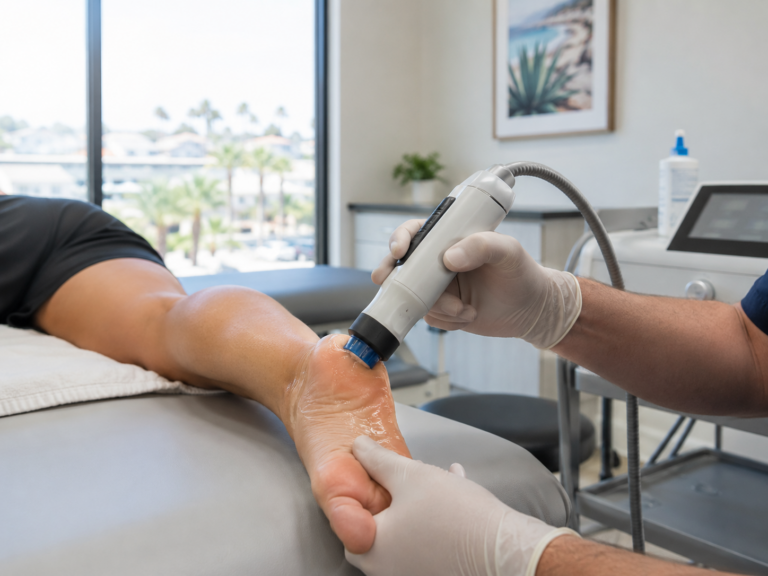
Before treatment. Your provider reviews your history, confirms the likely source of pain, and identifies the precise area to target. A coupling gel is applied so the waves transmit efficiently into the tissue.
During treatment. A handheld applicator delivers the pulses to the heel and arch. Sessions are usually brief — often around 5 to 15 minutes of active treatment. Most patients feel a tapping or pulsing sensation, and intensity can be adjusted for comfort. Some tenderness during treatment is normal; if you are curious about sensation, our article on whether shockwave therapy hurts walks through what to expect.
After treatment. There is typically little to no downtime. You can usually walk out and resume light daily activities, though your provider may suggest easing off high-impact loading for a day or two. Mild soreness afterward is common and usually short-lived.
Shockwave therapy is generally delivered as a short series of sessions spaced about a week apart rather than a single appointment. Your provider will recommend a plan based on your response.
Treatment Outcomes and What Patients Can Expect
It is important to set realistic expectations: results vary from person to person, and shockwave therapy is not a guaranteed cure. That said, many patients with chronic plantar fasciitis pursue it because they are looking for a non-surgical option after other approaches have fallen short.
Patients often report gradual, cumulative changes rather than instant relief. Improvement, when it happens, tends to build over the course of a treatment series and in the weeks that follow as the tissue continues to respond. Some people notice changes earlier; others need the full course before they can judge the effect. Factors that can influence results include how long the pain has been present, overall foot mechanics and footwear, activity demands, body weight, and how consistently you follow supportive measures like stretching and load management.
A typical course often involves several sessions, though the exact number depends on your condition and response — you can read about how many sessions you may need and review general recovery basics to understand the timeline. Shockwave therapy is also frequently used alongside, not instead of, other care; if you are weighing approaches, our comparison of shockwave versus physical therapy may help.
Your provider will track your progress and adjust the plan accordingly. If shockwave therapy is not the right fit for your situation, they can discuss alternatives.
Our Patient Care Process
We keep the process clear and structured so you always know what comes next:
- Initial consultation. We listen to your goals and understand how heel pain is affecting your daily life.
- Medical history and symptom review. We review onset, activity patterns, prior treatments, and what has and hasn’t helped.
- Physical exam and diagnostic review. We assess the foot, confirm the likely source of pain, and rule out symptoms that point elsewhere. If imaging or further workup is appropriate, we discuss it.
- Personalized treatment planning. We recommend whether shockwave therapy is a reasonable option for you, how many sessions a course might involve, and what supportive steps to pair with it.
- Treatment. Sessions are delivered in-office, typically spaced about a week apart.
- Follow-up care. We check in on your response, manage any soreness, and refine the plan.
- Progress tracking. We measure how your symptoms change over time so decisions are based on your actual results, not guesswork.
Why Choose San Diego Shockwave Therapy Center
At San Diego Shockwave Therapy Center, our focus is squarely on shockwave-based care for chronic soft-tissue and tendon pain — including plantar fasciitis. That focus means a treatment process built specifically around this approach, modern equipment, and a care team that takes time to understand your situation before recommending a plan.
We prioritize honest, balanced communication. We will tell you when shockwave therapy is a reasonable option to try, and we will be straightforward if your situation calls for something else. Our Carlsbad location makes consistent, weekly sessions practical for people across North County, and we provide transparent pricing so there are no surprises. If you are comparing providers, our guide to choosing a shockwave therapy clinic outlines what to look for, and our safety guide covers candidacy considerations.

Serving Carlsbad and North County San Diego
Our clinic sits at 2623 Gateway Rd in Carlsbad, convenient to surrounding North County communities and the greater San Diego area. Carlsbad is an active place — coastal trails, golf, beach walks, youth and adult sports leagues, and plenty of jobs that keep people on their feet all day in retail, hospitality, and the trades. Each of those activities can contribute to the repetitive loading that aggravates the plantar fascia.
That local context shapes how we treat. A retail worker on a hard floor, a runner training along the coast, and an office commuter who exercises on weekends all develop heel pain for different reasons and have different goals. Being based in Carlsbad lets patients keep up the weekly cadence that a shockwave course often requires without a long drive, while still being accessible to neighbors throughout San Diego County who want a focused, non-surgical option for stubborn heel pain.
Cost, Insurance, and Payment Expectations
Shockwave therapy costs vary based on the condition being treated and the number of sessions required. Individual sessions typically start around $75+, with package deals offering meaningful savings for a full course of care. When compared to the long-term costs of ongoing medications, repeated injections, or surgery — including recovery time away from work and activity — many patients find shockwave therapy to be a cost-effective option.
Your final cost depends on several factors, including:
- The condition being treated and its severity
- Consultation and any diagnostic findings
- The number of treatments in your recommended course
- The treatment type and session length
- Whether you choose individual sessions or a package
- Insurance coverage, where applicable, and whether care is self-pay
- Any recommended follow-up care
We believe in transparent pricing. After your evaluation, we will provide a detailed, personalized cost estimate so you know exactly what to expect before you commit. For general guidance, see our pages on shockwave therapy cost and lower-cost shockwave therapy options.
Medical References
- Physiopedia. Extracorporeal Shockwave Therapy.
This page is for general educational purposes and does not replace a professional medical evaluation. Diagnosis and treatment recommendations depend on an individual assessment.
Ready to Take the First Step Without the Pain?
You don’t have to keep planning your day around heel pain. If stubborn plantar fasciitis is slowing you down, shockwave therapy may help you get back to walking, working, and staying active in Carlsbad — without surgery and without lengthy downtime. The first step is a straightforward consultation to confirm what’s causing your pain and whether shockwave therapy is a good fit for you.
Call San Diego Shockwave Therapy Center today at +1 760-477-4760 to schedule your consultation. We’ll review your symptoms, answer your questions, and provide a clear, personalized estimate — so you can make a confident, informed decision about your care.
📍 2623 Gateway Rd #104, Carlsbad, CA 92009 🕒 Mon–Fri 10:00 a.m.–6:00 p.m. | Sat 10:00 a.m.–4:00 p.m.
Frequently Asked Questions
1. What is shockwave therapy for plantar fasciitis?
1. What is shockwave therapy for plantar fasciitis?
Shockwave therapy for plantar fasciitis is a non-surgical treatment that delivers focused acoustic pressure waves to the irritated tissue at the bottom of the foot. The pulses are thought to stimulate a local healing response and help reduce pain. It is commonly used for chronic heel pain that hasn’t fully resolved with rest, stretching, or orthotics, and it requires no incisions or injections.
2. Does shockwave therapy hurt?
2. Does shockwave therapy hurt?
Most patients feel a tapping or pulsing sensation during treatment, and some tenderness over the sore area is normal. Intensity can usually be adjusted for comfort. Sessions are brief, and mild soreness afterward is common but typically short-lived. Everyone’s tolerance differs, so let your provider know what you feel during the session so they can adjust.
3. How many sessions will I need?
3. How many sessions will I need?
Shockwave therapy is usually delivered as a short series rather than a single visit, with sessions commonly spaced about a week apart. The exact number depends on your condition, how long you’ve had symptoms, and how you respond. Your provider will recommend a plan after your evaluation and adjust it based on your progress.
4. How soon will I see results?
4. How soon will I see results?
Results vary. Many patients notice gradual, cumulative improvement over the treatment course and in the weeks afterward, rather than immediate relief. Some respond sooner, while others need the full series before judging the effect. Factors like symptom duration, footwear, activity level, and consistency with supportive measures all influence the timeline.
5. Is shockwave therapy safe?
5. Is shockwave therapy safe?
Shockwave therapy is widely used as a conservative, non-surgical option, and there is typically little to no downtime. As with any treatment, it isn’t right for everyone, and certain conditions may make it unsuitable. That’s why an individual evaluation matters — your provider will review your history to confirm whether it’s an appropriate option for you.
6. Is there any downtime after treatment?
6. Is there any downtime after treatment?
Usually not. Most patients walk out and resume light daily activities right away. Your provider may suggest easing off high-impact loading for a day or two, and mild soreness afterward is common. You can ask about activity guidance specific to your situation during your visit.
7. How much does shockwave therapy for plantar fasciitis cost in Carlsbad?
7. How much does shockwave therapy for plantar fasciitis cost in Carlsbad?
Individual sessions typically start around $75+, with package deals offering savings for a full course. Your total depends on the number of sessions, treatment type, and any follow-up care. We provide a detailed, personalized estimate after your evaluation so there are no surprises.
8. Will my insurance cover shockwave therapy?
8. Will my insurance cover shockwave therapy?
Coverage varies by plan, and in many cases shockwave therapy is offered as a self-pay service. We can discuss your options during your consultation and explain costs clearly before you begin. Checking with your insurer about your specific benefits is also a good idea.
9. Who is a good candidate for shockwave therapy?
9. Who is a good candidate for shockwave therapy?
People with chronic plantar fasciitis or other persistent soft-tissue and tendon pain that hasn’t responded well to first-line care often consider shockwave therapy. Candidacy depends on your diagnosis, health history, and individual exam, so the best way to find out is a personal evaluation with a provider.
10. Can shockwave therapy treat conditions other than plantar fasciitis?
10. Can shockwave therapy treat conditions other than plantar fasciitis?
Yes. The same approach is commonly used for Achilles tendon pain, tennis and golfer’s elbow, jumper’s knee, hip and gluteal tendon pain, shoulder tendinopathy, and sports-related overuse injuries. If you have pain in more than one area, an evaluation can help prioritize and plan your care.
11. Is shockwave therapy better than physical therapy?
11. Is shockwave therapy better than physical therapy?
They serve different roles and are often used together rather than as either/or. Physical therapy builds strength and mechanics, while shockwave therapy targets the irritated tissue directly. The right combination depends on your situation — our comparison of shockwave versus physical therapy explains the differences in more detail.
12. Do I need a referral to book an appointment?
12. Do I need a referral to book an appointment?
In most cases you can schedule a consultation directly with our Carlsbad clinic. We’ll review your history and symptoms and let you know whether shockwave therapy is a reasonable option. If your situation calls for additional workup or a different approach, we’ll discuss that with you.
13. Where is your shockwave therapy clinic located?
13. Where is your shockwave therapy clinic located?
We’re located at 2623 Gateway Rd #104, Carlsbad, CA 92009, serving patients throughout North County and the greater San Diego area. Our hours are Monday through Friday from 10:00 a.m. to 6:00 p.m. and Saturday from 10:00 a.m. to 4:00 p.m.