
Shockwave Therapy for Shoulder Pain in Carlsbad, CA
Shockwave therapy for shoulder pain is a non-surgical, drug-free treatment that uses targeted acoustic pressure waves to stimulate the body’s natural healing response in injured tendons and soft tissue. At San Diego Shockwave Therapy Center in Carlsbad, this approach is used to support pain relief and improved mobility for patients dealing with chronic rotator cuff problems, calcific tendinitis, and other stubborn shoulder conditions — without medication, injections, or downtime.
If you’ve been living with shoulder pain that hasn’t improved with rest, anti-inflammatories, or basic stretching, you’re not alone. Shoulder pain is one of the most common reasons people in Carlsbad and across San Diego County seek out musculoskeletal care, and it can quietly chip away at sleep, work, workouts, and everyday tasks like reaching a shelf or fastening a seatbelt. The good news is that there are conservative, evidence-informed options worth exploring before considering more invasive steps.
Why Shoulder Pain Deserves Proper Evaluation
The shoulder is the most mobile joint in the body, which also makes it one of the most vulnerable to overuse and degenerative change. Tendons in the rotator cuff and surrounding structures absorb a tremendous amount of repetitive load — every overhead lift, swim stroke, surf paddle, golf swing, or hour spent at a keyboard adds up over time.
When pain lingers, it usually isn’t “just getting older.” Persistent shoulder pain is often a sign that a tendon is irritated, degenerating, or carrying a calcium deposit, and these conditions tend to respond best when they’re identified and addressed thoughtfully rather than pushed through. Left unmanaged, shoulder pain can lead to compensation patterns, reduced range of motion, and deconditioning that make recovery slower down the road.
A proper evaluation matters because shoulder pain has many possible sources, and the right plan depends on the right diagnosis. Understanding what shockwave therapy is and where it fits among your options is a helpful starting point — but it should always sit alongside an individualized assessment, not replace one.
Shoulder Conditions and Symptoms This Service May Help
Extracorporeal shockwave therapy (ESWT) is most often used for chronic, soft-tissue and tendon-related shoulder problems that haven’t responded well to a few weeks of conservative care. Patients frequently seek care when they notice the symptoms and conditions below.
| Condition or Concern | Common Symptoms Patients Describe |
|---|---|
| Calcific tendinitis of the rotator cuff | Sharp or deep shoulder pain, often worse with overhead movement; pain that can flare intensely as deposits irritate the tendon |
| Rotator cuff tendinopathy | A persistent ache, weakness when lifting, and pain reaching overhead or behind the back |
| Supraspinatus tendinopathy | Pain on the outer/top shoulder, especially when raising the arm to the side |
| Subacromial / impingement-related pain | A pinching sensation with certain arm positions and discomfort lying on the affected side |
| Biceps tendinopathy | Front-of-shoulder pain that may travel down the arm, aggravated by lifting or twisting |
| Chronic overuse from sport or work | Lingering soreness from swimming, surfing, tennis, weightlifting, or repetitive overhead tasks |

Shockwave therapy is also widely used for other parts of the body, including plantar fasciitis, Achilles tendon pain, tennis elbow, jumper’s knee, and hip pain — so many patients who first come in for shoulder pain are also dealing with sports-related overuse injuries elsewhere. Because the treatment targets the same underlying tissue-healing process wherever it’s applied, it can sometimes address more than one trouble spot over a course of care. If you’re managing pain in several areas, it’s worth mentioning during your consultation so your plan can account for it.
It’s important to be balanced: shockwave therapy may help reduce pain and support function in these conditions, but results vary from person to person, and not every shoulder problem is a good fit. Some causes of shoulder pain — such as full-thickness tears, instability, fractures, or certain inflammatory conditions — call for a different approach. That’s exactly why an individual evaluation comes first.
How Shockwave Therapy for Shoulder Pain Works
Shockwave therapy delivers high-energy acoustic pressure waves through the skin to the targeted area of the shoulder. Rather than masking pain, the goal is to stimulate a biological healing response in tissue that has become “stuck” in a chronic, under-healing state.
The pressure waves are thought to work in several ways: they may encourage new blood-vessel formation (neovascularization) to improve circulation in poorly healing tendons, help break down calcium deposits in calcific tendinitis, and influence how the area processes pain signals. You can read a deeper explanation of how shockwave therapy works and the broader benefits of shockwave therapy on our related pages.
Here’s what the experience generally looks like:
Before treatment. Your provider reviews your history and symptoms, examines your shoulder, and confirms whether shockwave therapy is appropriate for you. A small amount of gel is applied to help transmit the waves.
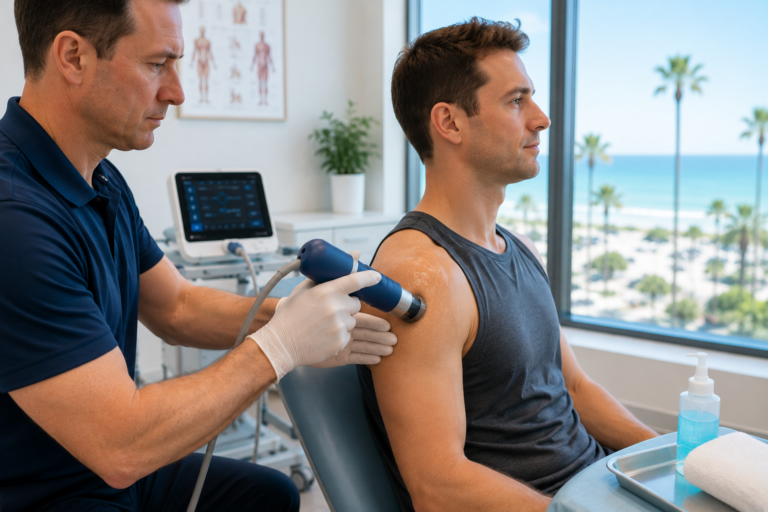
During treatment. A handheld applicator is moved across the treatment area while pulses are delivered. Sessions are typically short — often around 10 to 20 minutes — and no anesthesia or incisions are involved. Many patients feel a tapping or mildly intense sensation, and settings can usually be adjusted for comfort. If you’re wondering about this, our page on whether shockwave therapy hurts walks through what to expect.
After treatment. Most people return to normal daily activity right away. Some mild, temporary soreness or redness in the treated area is common for a day or two. There’s generally no extended downtime, though your provider may suggest easing off aggravating activities for a short period.
Treatment Outcomes and What Patients Can Expect
Shockwave therapy is usually delivered as a short series rather than a single visit. Many treatment plans involve a course of sessions — often around three to six — spaced roughly a week apart, though the exact number depends on your condition, its severity, and how you respond. Our overview of how many shockwave sessions you might need explains this in more detail.

Improvement often builds gradually in the weeks following treatment as the healing response unfolds, rather than appearing all at once. Patients commonly report goals like less day-to-day pain, easier overhead movement, better sleep, and a return to activities they’d been avoiding.
That said, honest expectations matter. Outcomes vary, some people respond more than others, and shockwave therapy is not a guaranteed cure or a permanent fix for every shoulder problem. Factors that can influence results include how long the condition has been present, the underlying diagnosis, overall health, activity demands, and how consistently you follow your full plan — which may include exercise and activity modification alongside treatment. Your provider will discuss realistic expectations for your specific situation during your consultation.
Our Patient Care Process
We keep the process clear and personalized from your first visit through follow-up:
- Initial consultation. We listen to your concerns, goals, and how shoulder pain is affecting your life.
- Medical history and symptom review. We discuss prior injuries, treatments you’ve already tried, activity demands, and any relevant health background.
- Physical exam or diagnostic review. We assess your shoulder’s movement, strength, and pain patterns, and review any imaging or records you bring.
- Personalized treatment planning. If shockwave therapy is appropriate, we outline a recommended course; if it isn’t the right fit, we’ll tell you and discuss alternatives.
- Treatment. Sessions are delivered in a comfortable, professional setting with adjustments made for your comfort.
- Follow-up care. We check in on your progress and refine the plan as needed.
- Progress tracking. We monitor changes in pain and function over your course of care so the plan stays aligned with your goals.
Because shockwave therapy is one of several conservative options, it can help to see how it compares to others. Our patients often review shockwave therapy vs. cortisone injections, shockwave therapy vs. physical therapy, and, for those weighing more invasive routes, shockwave therapy vs. surgery.
Why Choose San Diego Shockwave Therapy Center
San Diego Shockwave Therapy Center is focused specifically on shockwave (extracorporeal pulse) therapy, which means it’s not an afterthought tucked into a broader practice — it’s the center of what we do. That focus shows up in how we evaluate candidacy, tailor each course of care, and communicate honestly about what shockwave therapy can and can’t do.
Patients choose us for our patient-centered approach, transparent communication, and convenient Carlsbad location. We take time to explain your options in plain language, set realistic expectations, and build a plan around your goals rather than a one-size-fits-all script. If you’d like to hear from others first, you can browse patient reviews to see how we communicate openly and prioritize your wellbeing every step of the way.
Serving Carlsbad and the Greater San Diego Area
Our clinic is conveniently located at 2623 Gateway Rd #104, Carlsbad, CA 92009, making non-surgical shoulder care accessible to patients throughout Carlsbad and the surrounding San Diego region.
Carlsbad is an active, coastal community — between surfing, swimming at the lagoons and beaches, golf, tennis, CrossFit and gym culture, and long hours at desks and worksites, shoulders here take a beating. Overhead athletes and weekend warriors are especially prone to rotator cuff and tendon irritation, while office workers and tradespeople often develop overuse pain from repetitive motion and posture. An aging but active local population also means more degenerative tendon conditions where conservative options are particularly appealing.
Whether you’re coming from Bressi Ranch, La Costa, Carlsbad Village, or elsewhere in San Diego County, our goal is to make it easy to get evaluated and start a plan that fits your lifestyle.
Cost, Insurance, and Payment Expectations
Shockwave therapy costs vary based on the condition being treated and the number of sessions required. Individual sessions typically start around $75, with package deals offering significant savings for a full course of care. When compared to the long-term costs of medications, repeated injections, or surgery (including recovery time and lost work), most patients find shockwave therapy to be a cost-effective option.
Your final cost depends on several factors, including your specific condition, consultation findings, how many treatments are recommended, and whether any follow-up care is needed. Coverage can also vary — many shockwave therapy services are offered on a self-pay basis, so it’s worth checking your individual plan if insurance is a consideration.
We believe in transparent pricing and will provide a detailed cost estimate during your consultation, so you know what to expect before starting. For more on this, see our dedicated page on shockwave therapy cost.
Medical References
For patients who want to learn more about the science behind this treatment, Physiopedia offers a clinically oriented overview of Extracorporeal Shockwave Therapy, including its proposed mechanisms and common applications.
This page is intended for general education only and does not replace a professional medical evaluation. Diagnosis and treatment recommendations depend on an individual assessment by a qualified provider.
Ready to Address Your Shoulder Pain?
You don’t have to keep working around shoulder pain or waiting for it to fade on its own. If you’re in Carlsbad or the surrounding San Diego area and you’re curious whether shockwave therapy for shoulder pain could support your recovery, the next step is a straightforward consultation.
Call San Diego Shockwave Therapy Center today at (760) 477-4760 to schedule your evaluation. We’ll assess your shoulder, answer your questions honestly, and build a personalized, non-surgical plan designed around your goals — so you can get back to the activities you’ve been missing.
📍 2623 Gateway Rd #104, Carlsbad, CA 92009 📞 (760) 477-4760 🕒 Mon–Fri: 10 a.m.–6 p.m. | Sat: 10 a.m.–4 p.m.
Frequently Asked Questions
What is shockwave therapy for shoulder pain?
What is shockwave therapy for shoulder pain?
Shockwave therapy for shoulder pain is a non-surgical treatment that delivers acoustic pressure waves to injured tendons and soft tissue around the shoulder. The goal is to stimulate the body’s natural healing response, support pain relief, and improve mobility. It’s commonly used for chronic conditions like rotator cuff tendinopathy and calcific tendinitis when basic conservative care hasn’t been enough. It involves no medication, injections, or incisions, and most sessions are brief.
Does shockwave therapy work for rotator cuff problems and calcific tendinitis?
Does shockwave therapy work for rotator cuff problems and calcific tendinitis?
Shockwave therapy is frequently used for chronic rotator cuff tendinopathy and calcific tendinitis, and many patients seek it specifically for these conditions. The pressure waves may help stimulate healing and, in calcific tendinitis, support the breakdown of calcium deposits. Results vary from person to person and depend on the exact diagnosis and severity. The best way to know if it’s likely to help your shoulder is through an individual evaluation.
How much does shockwave therapy for shoulder pain cost in Carlsbad?
How much does shockwave therapy for shoulder pain cost in Carlsbad?
Costs vary based on your condition and the number of sessions needed. Individual sessions typically start around $75, and package pricing for a full course often provides meaningful savings. Many patients find it cost-effective compared with long-term medication, repeated injections, or surgery. We provide a detailed, personalized estimate during your consultation, so you’ll know your expected cost before beginning treatment.
Is shockwave therapy for shoulder pain painful?
Is shockwave therapy for shoulder pain painful?
Most patients tolerate shockwave therapy well. During a session you may feel a tapping or mildly intense sensation in the treated area, and the intensity can usually be adjusted for your comfort. Some mild, temporary soreness or redness afterward is normal and typically settles within a day or two. No anesthesia is required, and most people return to their usual activities right away.
How many sessions will I need?
How many sessions will I need?
Many shoulder treatment plans involve a course of roughly three to six sessions spaced about a week apart, though the exact number depends on your condition, its severity, and how you respond. Your provider will recommend a plan after evaluating your shoulder and discuss adjustments as your treatment progresses.
How soon will I see results?
How soon will I see results?
Improvement often builds gradually in the weeks following treatment as the healing response develops, rather than all at once. Some patients notice changes sooner, others take longer, and outcomes vary based on the underlying condition and individual factors. Your provider will set realistic expectations for your specific situation.
Is shockwave therapy safe?
Is shockwave therapy safe?
Shockwave therapy is generally considered a low-risk, non-invasive option, which is part of its appeal. The most common effects are short-term soreness or redness in the treated area. As with any treatment, it isn’t right for everyone, and certain conditions or situations may make it unsuitable. A thorough evaluation helps confirm whether it’s a safe and appropriate choice for you.
Who is a good candidate for shockwave therapy?
Who is a good candidate for shockwave therapy?
Good candidates are often patients with chronic, soft-tissue or tendon-related shoulder pain that hasn’t fully responded to rest, activity changes, or other conservative care. Candidacy depends on your diagnosis, symptoms, and overall health. Some shoulder problems and certain medical conditions call for a different approach, which is why an individual assessment is essential before starting.
Is shockwave therapy covered by insurance?
Is shockwave therapy covered by insurance?
Coverage varies, and many shockwave therapy services are offered on a self-pay basis. Because plans differ, it’s worth checking your individual policy if insurance is a factor for you. During your consultation we’ll explain our transparent pricing and package options so you can make an informed decision.
How is shockwave therapy different from cortisone injections?
How is shockwave therapy different from cortisone injections?
Cortisone injections aim to reduce inflammation and can offer short-term relief, while shockwave therapy is a non-injection approach intended to stimulate longer-term tissue healing. Each has different goals, benefits, and considerations. Many patients compare the two when deciding on care; our page comparing shockwave therapy and cortisone injections explores the differences in more detail.
Can shockwave therapy help me avoid shoulder surgery?
Can shockwave therapy help me avoid shoulder surgery?
For some patients with chronic tendon-related shoulder pain, shockwave therapy is a conservative option to try before considering surgery. It may help support pain relief and function without the risks and recovery of an operation. However, it isn’t a substitute for surgery in every case, and outcomes vary. The right path depends on your specific diagnosis and an individual evaluation.
What should I expect during a session?
What should I expect during a session?
After applying gel to the area, your provider moves a handheld applicator over the shoulder while delivering pulses. Sessions are typically short — often around 10 to 20 minutes — with no anesthesia or incisions. You may feel a tapping sensation, and settings can be adjusted for comfort. Most people resume normal activity immediately afterward.
Are there side effects?
Are there side effects?
Side effects are usually mild and temporary, most commonly short-lived soreness, redness, or minor swelling in the treated area. These typically resolve within a day or two. Your provider will review the relevant considerations for your situation and answer any questions before you begin.
Where is your Carlsbad clinic located?
Where is your Carlsbad clinic located?
San Diego Shockwave Therapy Center is located at 2623 Gateway Rd #104, Carlsbad, CA 92009, serving patients throughout Carlsbad and the greater San Diego area. We’re open Monday through Friday from 10 a.m. to 6 p.m. and Saturday from 10 a.m. to 4 p.m.
How do I book an appointment for shoulder pain?
How do I book an appointment for shoulder pain?
Booking is simple — call us at (760) 477-4760 to schedule a consultation. During your visit we’ll evaluate your shoulder, explain whether shockwave therapy is a good fit, and outline a personalized plan with clear pricing.