
Shockwave Therapy vs Cortisone Injections: Which Heals Faster and Lasts Longer?
When chronic tendon or joint pain won’t quit, two treatments dominate the conversation—but they work in completely opposite ways.
For most people, cortisone injections deliver faster short-term relief, while shockwave therapy offers longer-lasting results by stimulating actual tissue healing rather than just masking inflammation. If your priority is rapid pain reduction for an acute flare-up, cortisone often wins; if you want to repair the underlying problem and avoid the risks of repeated steroids, shockwave therapy is usually the smarter long-term choice. Below, we break down the shockwave therapy vs cortisone injections debate in full—how each works, what they cost in San Diego, their pros and cons, and exactly which scenarios favor one over the other.
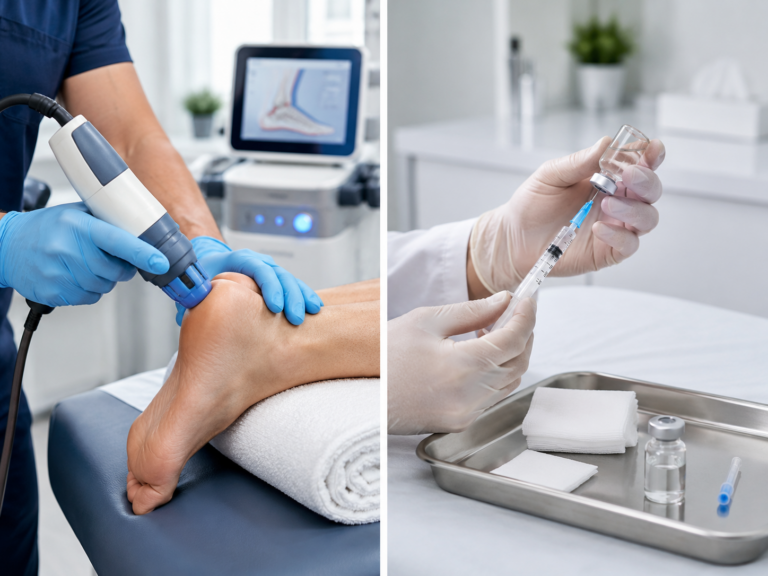
Understanding Shockwave Therapy

Shockwave therapy—clinically known as Extracorporeal Shockwave Therapy (ESWT)—is a non-invasive treatment that uses high-energy acoustic pressure waves to stimulate the body’s natural healing response. A handheld applicator delivers these waves through the skin to the injured tendon, ligament, or soft tissue.
How it works: The acoustic waves create controlled micro-trauma at the treatment site. This triggers increased blood flow (angiogenesis), stimulates collagen production, and helps break down calcium deposits and scar tissue. Rather than suppressing your body’s response, shockwave therapy provokes a fresh round of repair in tissue that has stalled in a chronic, under-healed state.
Typical costs: In San Diego, sessions generally run $100 to $400 each, with most treatment plans calling for 3 to 6 sessions spaced about a week apart. A full course often lands between $300 and $2,000. ESWT is frequently considered elective, so it’s often paid out of pocket rather than billed to insurance—something worth confirming during your consultation.
Core benefits: No needles, no anesthesia, no downtime, and no medication entering your body. Sessions take roughly 10–20 minutes, and you can typically walk out and resume light activity the same day—convenient for San Diego’s active, beach-and-trail lifestyle.
Ideal use cases: Plantar fasciitis, Achilles tendinopathy, tennis and golfer’s elbow, patellar (jumper’s) knee, calcific shoulder tendinitis, and other chronic tendon conditions that haven’t responded to rest or basic physical therapy.
Understanding Cortisone Injections
A cortisone injection delivers a corticosteroid—a powerful anti-inflammatory medication—directly into or around an inflamed joint or tendon, usually combined with a local anesthetic for immediate numbing.
How it works: Cortisone is a synthetic version of a hormone your body produces. Injected at the source, it rapidly suppresses the inflammatory cascade that drives swelling and pain. The result is often dramatic relief within days. Importantly, cortisone calms inflammation—it does not rebuild or strengthen damaged tissue.
Typical costs: Out of pocket, a cortisone injection in San Diego typically runs $100 to $300, and more when ultrasound guidance is used for precise placement. Because cortisone is an established medical treatment, it’s more likely to be covered by insurance, often leaving you with just a copay—a meaningful difference in the shockwave therapy vs cortisone injections cost equation.
Core benefits: Speed and simplicity. Relief can arrive within 24–72 hours, the procedure takes minutes, and a single injection can quiet a painful flare for weeks or months.
Ideal use cases: Acute inflammatory flares, arthritis pain, bursitis, and situations where a patient needs fast functional relief—for example, to get through a major event or to tolerate a rehab program. There’s a catch: most physicians limit cortisone to roughly 3–4 injections per year per site, because repeated steroids can weaken tendons and degrade cartilage over time.

| Attribute | Shockwave Therapy (ESWT) | Cortisone Injections |
|---|---|---|
| Upfront Cost | $100–$400 per session ($300–$2,000 per course) | $100–$300 per injection |
| Insurance Coverage | Often out of pocket (elective) | Frequently covered, often just a copay |
| Speed of Relief | Gradual—builds over several weeks | Rapid—often within 24–72 hours |
| Lasting Power | Long-lasting; targets root cause | Temporary; weeks to a few months |
| Mechanism | Stimulates tissue healing & blood flow | Suppresses inflammation only |
| Invasiveness | Non-invasive, no needles | Injection through the skin |
| Sessions Needed | Typically 3–6 | Often 1, limited to ~3–4/year/site |
| Downtime | None | Minimal (rest the area 24–48 hrs) |
| Key Risk | Temporary soreness/redness | Tendon weakening, cartilage damage with repeat use |
Pros and Cons Breakdown
Pros of Shockwave Therapy
- Treats the root cause – Stimulates genuine tissue repair instead of only masking symptoms.
- Non-invasive and drug-free – No needles, anesthesia, or medication side effects.
- Long-lasting results – Many patients see sustained improvement well after the final session.
- No meaningful downtime – Ideal for staying active year-round in San Diego’s mild climate.
- Safe to repeat – Without the cumulative tissue risks associated with steroids.
Cons of Shockwave Therapy
- Slower to deliver relief – Improvement builds over weeks, not days.
- Multiple sessions required – A bigger time commitment than a single injection.
- Often out of pocket – Less likely to be covered by insurance.
- Temporary discomfort – Mild soreness or redness can follow a session.
Pros of Cortisone Injections
- Fast, dramatic relief – Often the quickest path out of an acute flare.
- Quick and convenient – A single appointment of just a few minutes.
- Usually insurance-friendly – Lower out-of-pocket cost for many patients.
- Highly effective for inflammation – Excellent for arthritis and bursitis flares.
Cons of Cortisone Injections
- Temporary fix – Pain frequently returns once the medication wears off.
- Doesn’t heal tissue – Addresses inflammation, not the underlying damage.
- Strict usage limits – Repeated injections can weaken tendons and erode cartilage.
- Possible side effects – Including a short-term “cortisone flare,” skin thinning, or temporary blood-sugar rise.
Which Option Is Better? (The Ultimate Showdown)
There’s no universal winner in the shockwave therapy vs cortisone injections matchup—the right call depends on your goals, your timeline, and the nature of your injury.
Choose cortisone injections if your priority is fast relief and your problem is driven by acute inflammation—an arthritic flare, bursitis, or a painful joint you need calmed down quickly. If insurance coverage and minimizing upfront cost matter most, the math often favors cortisone in the short term. It’s also a reasonable bridge to get you comfortable enough to begin a rehab program.
Choose shockwave therapy if you’re dealing with a chronic tendon problem—plantar fasciitis, Achilles or elbow tendinopathy—that keeps coming back, and you want to fix the underlying tissue rather than repeatedly silence the symptoms. While the upfront investment can be higher and relief takes longer to build, the long-term value is compelling: one course of treatment may resolve an issue that would otherwise demand cortisone shot after cortisone shot.
The cost-versus-benefit reality: cortisone is cheaper and faster today, but for recurring conditions, the repeat-injection cycle adds up financially and carries real tissue risk. Shockwave therapy asks for more patience and a larger initial outlay, yet often proves the better long-term investment by ending the cycle. For many San Diego patients with stubborn, chronic tendon pain, shockwave therapy is the durable winner—while cortisone remains the go-to for acute, inflammation-driven relief.
Many providers also use the two strategically together: a cortisone injection to break a severe pain cycle, followed by shockwave therapy to do the actual rebuilding.
Conclusion & Recommendation
In the shockwave therapy vs cortisone injections decision, the smartest choice comes down to whether you want to mask the pain or heal it. Cortisone injections are the faster, cheaper, more insurance-friendly option for calming acute inflammation—but the relief is temporary and the injections can’t be repeated indefinitely. Shockwave therapy costs more upfront and works gradually, yet it targets the root cause and tends to deliver longer-lasting results without medication or downtime.
Our recommendation: For one-off inflammatory flares, cortisone is a sensible first step. For chronic, recurring tendon and soft-tissue pain, shockwave therapy is typically the better long-term value. The ideal path is the one matched to your diagnosis—which is exactly what a proper evaluation is for.
Ready to Find Lasting Relief in San Diego?
If chronic pain is holding you back, you don’t have to choose blindly. Our San Diego team will assess your condition and help you decide whether shockwave therapy, cortisone, or a combined approach makes the most sense for you. Learn more about how shockwave therapy works or book a consultation at our San Diego clinic to get a personalized plan.
Frequently Asked Questions
1. Which is more effective, shockwave therapy or cortisone injections?
1. Which is more effective, shockwave therapy or cortisone injections?
It depends on the condition. For acute inflammation, cortisone is often more effective at producing fast relief. For chronic tendon problems, shockwave therapy is generally more effective long-term because it promotes actual tissue healing rather than temporarily suppressing inflammation.
2. Can I get shockwave therapy and cortisone injections together?
2. Can I get shockwave therapy and cortisone injections together?
Yes. Many San Diego providers use them strategically—a cortisone injection to quickly calm a severe flare, followed by a course of shockwave therapy to repair the underlying tissue. Your provider will advise on timing.
3. How much does shockwave therapy cost compared to cortisone in San Diego?
3. How much does shockwave therapy cost compared to cortisone in San Diego?
Shockwave therapy typically runs $100–$400 per session over 3–6 sessions, while a cortisone injection runs about $100–$300. Cortisone is more often covered by insurance, but shockwave may save money long-term by reducing the need for repeat treatments.
4. Is shockwave therapy painful?
4. Is shockwave therapy painful?
Most patients describe it as mild to moderate discomfort during the session, often compared to a tapping or pulsing sensation. Intensity can be adjusted, and there’s no needle involved. You can read more in our does shockwave therapy hurt? guide.
5. How long does relief from each treatment last?
5. How long does relief from each treatment last?
Cortisone relief is typically temporary—weeks to a few months—because it doesn’t repair tissue. Shockwave therapy results build gradually but tend to last much longer, since the treatment addresses the root cause of the injury.
6. Are there risks to repeated cortisone injections?
6. Are there risks to repeated cortisone injections?
Yes. Repeated cortisone shots can weaken tendons and degrade cartilage over time, which is why most physicians limit them to roughly 3–4 per year per site. Shockwave therapy does not carry these cumulative tissue risks.
7. How many shockwave therapy sessions will I need?
7. How many shockwave therapy sessions will I need?
Most treatment plans involve 3 to 6 sessions, usually spaced about a week apart. The exact number depends on your condition and how you respond. See our how many sessions guide for details.
8. Is there any downtime after these treatments?
8. Is there any downtime after these treatments?
Shockwave therapy has essentially no downtime—you can resume light activity the same day. Cortisone injections usually require resting the treated area for 24–48 hours. Both are convenient for San Diego’s active lifestyle.
9. Which treatment is better for plantar fasciitis?
9. Which treatment is better for plantar fasciitis?
Shockwave therapy is often preferred for chronic plantar fasciitis because it stimulates healing of the plantar fascia, while cortisone can provide faster but shorter-lived relief and carries a small risk to the fat pad and fascia with repeated use. Learn more on our plantar fasciitis treatment page.
10. How do I know which option is right for me?
10. How do I know which option is right for me?
The best way is a professional evaluation. A clinician will consider your diagnosis, how long you’ve had the issue, prior treatments, and your goals before recommending shockwave therapy, cortisone, or a combination.