
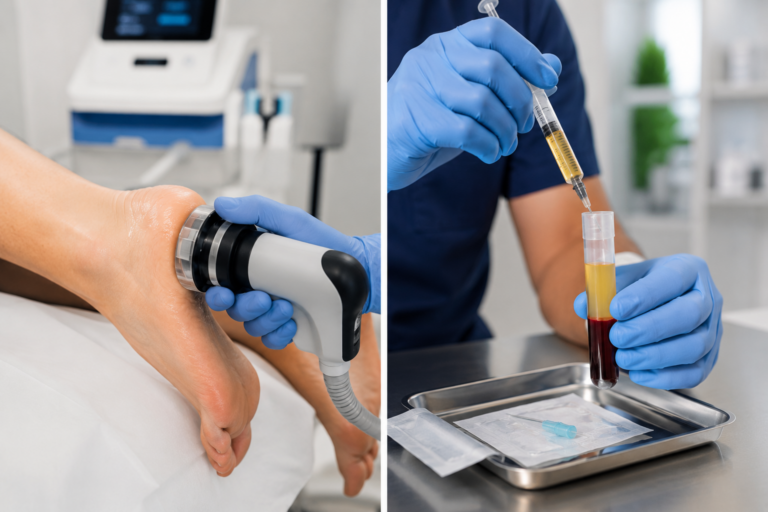
Understanding Shockwave Therapy
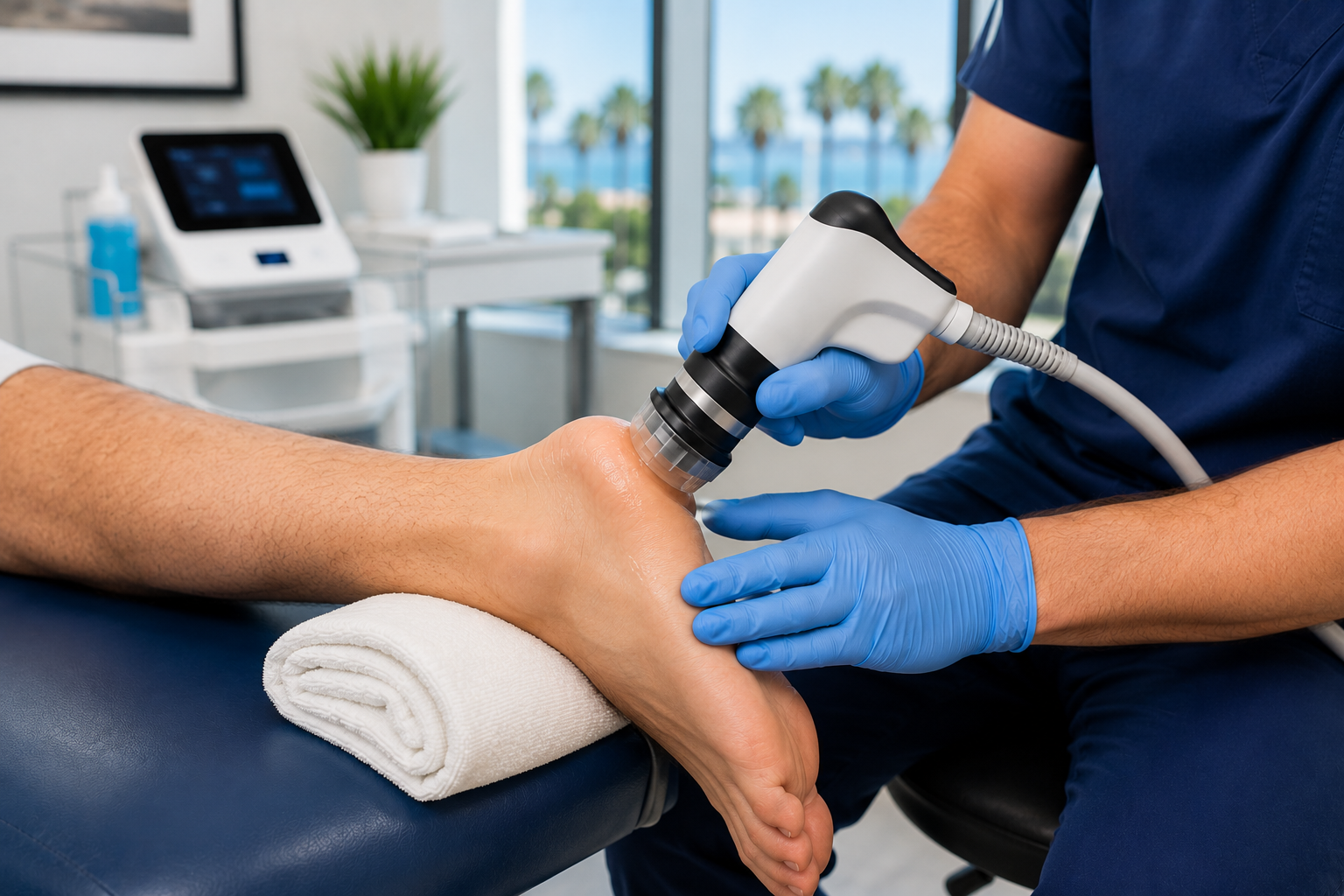 Shockwave therapy — clinically known as Extracorporeal Shockwave Therapy (ESWT) — is a non-invasive treatment that delivers acoustic pressure waves through the skin into injured tissue. There are no needles and no incisions. Instead, a handheld applicator pulses energy into the painful area, which stimulates blood flow, breaks down calcified or scarred tissue, and triggers your body’s natural healing cascade. If you want the mechanics in more depth, our explainer on how shockwave therapy works walks through it step by step.
How it works: A typical session lasts 10–20 minutes. The provider applies gel and moves the applicator over the target area while it delivers a few thousand pulses. Most people feel a tapping or mild discomfort during treatment, but no anesthesia is required and you walk out and resume your day — which is why it fits so neatly into San Diego’s go-go-go, beach-and-trail lifestyle.
Typical costs: Shockwave therapy generally runs $200–$450 per session, with most clinics structuring treatment as a package of 3–6 sessions for a total cost of roughly $600–$2,000. You can see how local rates break down in our San Diego shockwave therapy cost guide. Like most regenerative care in California, it’s typically paid out of pocket rather than billed to insurance.
Core benefits: It’s needle-free, has essentially no downtime, carries a very low complication risk, and is FDA-cleared for conditions like chronic plantar fasciitis.
Ideal use cases: Plantar fasciitis and heel pain, Achilles and patellar tendinopathy, tennis and golfer’s elbow, and other chronic tendon problems that haven’t responded to rest or physical therapy. Our plantar fasciitis treatment overview and knee pain guide cover the two most common reasons San Diego patients book a session.
Understanding PRP
PRP, or Platelet-Rich Plasma therapy, is an injection-based regenerative treatment. A provider draws a small sample of your blood, spins it in a centrifuge to concentrate the platelets and growth factors, then injects that concentrate directly into the injured joint, tendon, or ligament. It’s the same body’s-own-healing philosophy as shockwave — just delivered with a needle to a precise internal target.
How it works: After a blood draw and roughly 10–15 minutes of processing, the concentrated plasma is injected, often under ultrasound guidance for accuracy. Because it’s an injection into tissue, patients usually have a few days of soreness or swelling at the site and may be advised to limit strenuous activity for a short window afterward.
Typical costs: A single PRP injection typically costs $500–$2,500, with national averages clustering around $700–$1,000 per injection. Many conditions require a short series, pushing total cost to roughly $1,500–$3,000. PRP for musculoskeletal use is considered investigational by the FDA, so it’s almost always out of pocket.
Core benefits: It delivers a high concentration of growth factors directly to a deep or internal target — something acoustic waves can’t always reach as precisely — making it valuable for intra-articular (inside-the-joint) problems.
Ideal use cases: Knee, hip, and shoulder osteoarthritis, certain ligament sprains, rotator cuff and other tendon tears, and cases where a targeted internal injection is the goal.
| Attribute | Shockwave Therapy (ESWT) | PRP (Platelet-Rich Plasma) |
|---|---|---|
| Method | Non-invasive acoustic pressure waves | Injection of your own concentrated platelets |
| Needles / Blood Draw | None | Yes — blood draw + injection |
| Cost per Session | ~$200–$450 | ~$500–$2,500 (avg ~$700–$1,000) |
| Typical Full Course | 3–6 sessions (~$600–$2,000) | 1–3 injections (~$1,500–$3,000) |
| Downtime | Essentially none | A few days of soreness; brief activity limits |
| Best For | Chronic tendon & heel pain (surface/mid-depth) | Joint arthritis & deep internal soft-tissue targets |
| Regulatory Status | FDA-cleared for conditions like plantar fasciitis | Considered investigational by FDA for MSK use |
| Insurance | Usually out of pocket | Usually out of pocket |
Pros and Cons Breakdown
Pros of Shockwave Therapy
- No needles, no downtime — you can treat on a lunch break and head straight to the office or the beach.
- Lower cost per course — a full plan often costs less than a single high-end PRP injection.
- Very low risk — no injection means no risk of injection-site infection or bleeding.
- Strong fit for chronic tendon pain — especially plantar fasciitis, where it’s FDA-cleared and well studied.
Cons of Shockwave Therapy
- Requires multiple visits — results build over a series rather than one appointment.
- Mild discomfort during pulses — tolerable for most, but noticeable.
- Less ideal for deep joint interiors — acoustic waves reach surface and mid-depth tissue best.
Pros of PRP
- Targets deep, internal structures — delivers growth factors directly inside a joint or to a specific tear.
- Often fewer appointments — sometimes a single injection or a short series.
- Useful for arthritis — a leading non-surgical option for knee, hip, and shoulder OA.
Cons of PRP
- Higher cost — frequently the more expensive route overall.
- It’s invasive — blood draw, injection, and a recovery window with soreness.
- Variable preparation — concentration and technique differ between clinics, which can affect results.
- Investigational status — strong evidence exists for some uses but is still evolving for others.
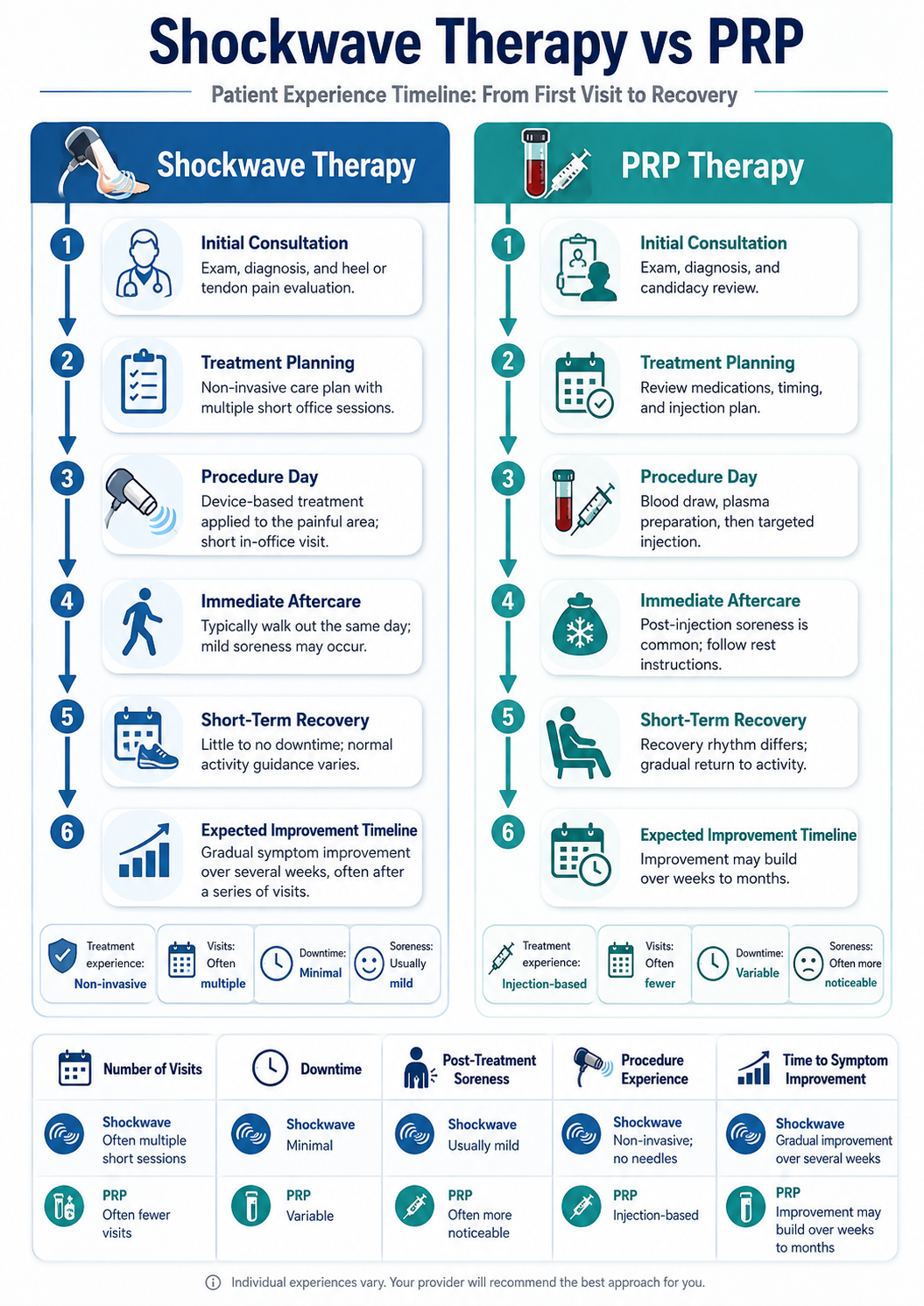
Which Option Is Better? The Ultimate Showdown
There’s no universal winner in the Shockwave Therapy vs PRP debate — there’s only the winner for your specific situation, budget, and pain.
Choose shockwave therapy if your problem is a chronic tendon or heel issue — plantar fasciitis, Achilles tendinopathy, tennis elbow — and you value a needle-free experience with zero downtime and a lower total cost. For the surfer nursing heel pain or the Cowles Mountain hiker with a cranky Achilles, shockwave’s “treat-and-go” convenience is hard to beat. On pure cost-versus-benefit, a 4-session shockwave course at roughly $1,000–$1,600 often delivers meaningful relief for less than a single premium PRP injection — and you avoid recovery downtime entirely.
Choose PRP if your issue is inside a joint — knee, hip, or shoulder arthritis — or a specific soft-tissue tear where a concentrated injection placed precisely at the target makes mechanical sense. PRP’s premium price can be justified when the condition genuinely calls for an internal, injected dose that surface acoustic waves can’t reach as directly.
For many San Diego patients, the deciding factors are simply needle tolerance, budget, and target depth. A useful rule of thumb: surface and mid-depth tendon pain leans shockwave; deep intra-articular joint pain leans PRP. And these aren’t mutually exclusive — some patients use them in sequence under a provider’s guidance. If you’re still torn between approaches generally, our shockwave vs. physical therapy comparison is a helpful companion read.
Conclusion & Recommendation
In the Shockwave Therapy vs PRP matchup, shockwave therapy is the stronger first-line choice for most chronic tendon and heel conditions thanks to its non-invasive nature, minimal downtime, lower cost, and strong safety profile — while PRP earns its place for joint arthritis and deep internal targets where a precise injection is warranted. The best path is the one matched to your exact diagnosis, and that’s a conversation worth having with a qualified provider before committing to either.
Get a San Diego Consultation
Not sure which treatment fits your pain? You don’t have to guess. A San Diego provider can examine your specific condition and recommend the approach most likely to get you back to the trails, the waves, and everyday life. Start by reading what shockwave therapy is, browse real patient reviews, and see why patients choose the best shockwave therapy clinic in San Diego. When you’re ready, book a consultation to map out a plan built around your goals.
This information is educational and not a substitute for individual medical advice. Treatment suitability should be confirmed with a licensed provider.
Frequently Asked Questions
1. Is shockwave therapy or PRP better for plantar fasciitis?
1. Is shockwave therapy or PRP better for plantar fasciitis?
For plantar fasciitis specifically, shockwave therapy is often the preferred first-line option because it’s FDA-cleared for the condition, non-invasive, and well studied for chronic heel pain. PRP is sometimes used when shockwave and conservative care haven’t worked.
2. Which is more expensive, shockwave therapy or PRP?
2. Which is more expensive, shockwave therapy or PRP?
PRP is usually more expensive overall. A single PRP injection often costs $500–$2,500, while a full shockwave course of 3–6 sessions typically totals $600–$2,000.
3. Does insurance in San Diego cover shockwave therapy or PRP?
3. Does insurance in San Diego cover shockwave therapy or PRP?
In most cases, neither is covered. Both shockwave therapy and PRP for musculoskeletal conditions are typically paid out of pocket in California, though some clinics offer package pricing or payment plans.
4. Is shockwave therapy painful compared to PRP?
4. Is shockwave therapy painful compared to PRP?
Shockwave therapy causes mild, tolerable discomfort during the pulses but requires no needles or anesthesia. PRP involves a blood draw and an injection, with a few days of soreness afterward. Our does shockwave therapy hurt guide covers what to expect.
5. How many sessions will I need?
5. How many sessions will I need?
Shockwave therapy usually requires 3–6 sessions spaced about a week apart, while PRP may involve a single injection or a short series. See our breakdown of how many shockwave sessions you might need.
6. Can I combine shockwave therapy and PRP?
6. Can I combine shockwave therapy and PRP?
In some cases, yes — a provider may use them in sequence or for different aspects of an injury. This should always be guided by a clinician who knows your full history.
7. Is there downtime after either treatment?
7. Is there downtime after either treatment?
Shockwave therapy has essentially no downtime; you can return to normal activity immediately. PRP typically involves a short recovery window with soreness and temporary activity restrictions.
8. How quickly will I see results?
8. How quickly will I see results?
Both are regenerative and build improvement over weeks, not overnight. Shockwave results often emerge over the course of treatment and continue improving for several weeks after the final session; PRP improvements also develop gradually as tissue heals.