
Shockwave Therapy vs Stem Cell Therapy: Which Path Actually Heals Your Pain?
If you’ve been nursing a stubborn injury through another sunny San Diego summer, you’ve probably hit the same crossroads thousands of locals face: do you try shockwave therapy or invest in stem cell therapy? For most people with chronic tendon, plantar, or joint-related pain, shockwave therapy is the smarter first choice—it’s non-invasive, far more affordable, and FDA-cleared for several common conditions. Stem cell therapy is generally reserved for more advanced joint degeneration or cases where conservative treatments like shockwave have already failed. In short: start conservative, escalate only if you need to.
This guide breaks down the real differences in the shockwave therapy vs stem cell therapy debate—how each works, what they cost, recovery realities, and exactly when one beats the other—so you can make a confident, informed decision.
Understanding Shockwave Therapy

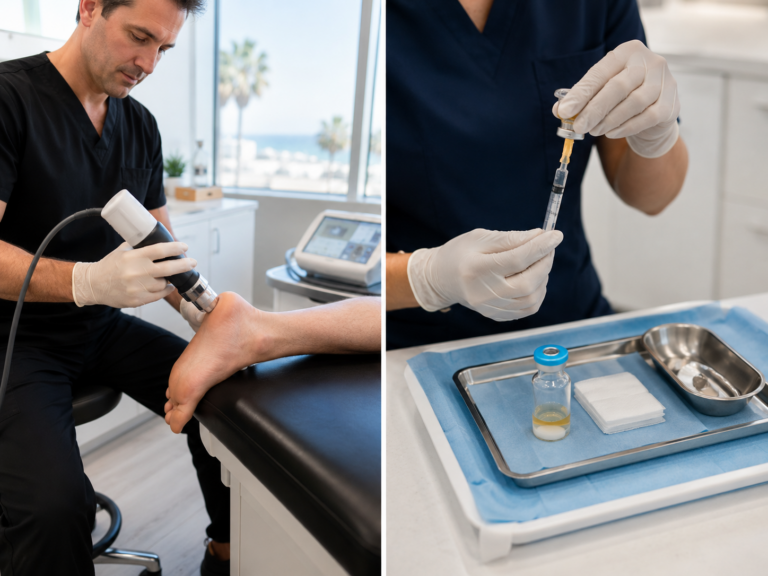
Shockwave therapy—clinically known as Extracorporeal Shockwave Therapy (ESWT)—uses high-energy acoustic pressure waves delivered through the skin to stimulate healing in damaged soft tissue. It’s completely non-invasive: no needles, no incisions, no anesthesia.
How it works: A handheld applicator sends rapid acoustic pulses into the targeted area. These pulses create controlled “micro-trauma” that tricks your body into restarting its natural repair process—boosting blood flow, breaking down calcified tissue and scar buildup, and triggering collagen production. Over a series of sessions, this regenerates healthier tissue where chronic inflammation had stalled.
Typical costs in San Diego: Most clinics charge roughly $200–$500 per session, with a full treatment course usually running 3 to 6 sessions. That puts a typical out-of-pocket course at around $1,000–$3,000, often less. You can dig deeper into local pricing on our shockwave therapy cost in San Diego page and our budget-focused affordable shockwave therapy options in San Diego guide.
Core benefits:
- Zero downtime—you can drive home and return to most daily activities the same day
- No surgery, needles, or medication
- FDA-cleared for several musculoskeletal conditions
- Cumulative, lasting improvement as tissue regenerates
Ideal use cases: Plantar fasciitis, Achilles and patellar tendinopathy, tennis/golfer’s elbow, calcific shoulder tendinitis, and chronic heel or knee pain. It shines for those frustrating overuse injuries that haven’t responded to rest or stretching. If you’re weighing it against other conservative routes, our shockwave vs physical therapy comparison for San Diego patients breakdown is worth a read.
Understanding Stem Cell Therapy
Stem cell therapy is a regenerative treatment that introduces concentrated cells—often harvested from your own bone marrow or fat tissue—directly into a damaged joint or tendon to encourage repair of cartilage and connective tissue.
How it works: A provider extracts stem cells (commonly via bone marrow aspiration or liposuction), processes them to concentrate the regenerative cells, then injects them under imaging guidance into the injury site. The goal is to recruit your body’s repair machinery to rebuild tissue that’s worn down or torn—something especially relevant for cartilage, which heals poorly on its own.
Typical costs in San Diego: Stem cell therapy is significantly more expensive, typically $3,000–$8,000 per treatment, and complex or multi-joint cases can climb well beyond that. Because most orthopedic stem cell procedures are not FDA-approved, they’re rarely covered by insurance and are usually paid out of pocket.
Core benefits:
- Targets deep structural damage like cartilage loss and significant tendon/ligament tears
- A single procedure may address issues that surface treatments can’t reach
- Potential to delay or avoid major surgery (e.g., joint replacement) in select cases
Ideal use cases: Moderate-to-severe osteoarthritis, cartilage defects, and certain ligament or tendon injuries where conservative care has been exhausted. It’s a more aggressive intervention for more advanced damage.

| Attribute | Shockwave Therapy | Stem Cell Therapy |
|---|---|---|
| Upfront Cost | $200–$500 per session ($1,000–$3,000 total) | $3,000–$8,000+ per treatment |
| Invasiveness | Non-invasive (no needles or surgery) | Invasive (tissue harvest + injection) |
| Downtime / Recovery | None to minimal; resume activity same day | Days to weeks of activity restriction |
| Sessions Needed | Typically 3–6 sessions | Often a single procedure |
| FDA Status | Cleared for specific conditions | Most orthopedic uses not FDA-approved |
| Insurance Coverage | Sometimes; often cash-pay | Rarely covered |
| Best For | Chronic tendon/plantar/heel pain | Advanced joint/cartilage degeneration |
| Risk Profile | Very low (mild soreness, bruising) | Higher (procedure & harvest-site risks) |
Pros and Cons Breakdown
Pros of Shockwave Therapy
- Affordable: A full course often costs less than a single stem cell session.
- No downtime: Ideal for active San Diegans who don’t want to pause work, surfing, or hiking Torrey Pines.
- Non-invasive and low-risk: No needles, anesthesia, or recovery period.
- FDA-cleared indications: Backed by clearance for conditions like chronic plantar fasciitis.
- Builds over time: Results accumulate and continue improving after the course ends.
Cons of Shockwave Therapy
- Requires multiple visits: You’ll commit to several appointments rather than one.
- Not for deep structural damage: Less effective for advanced cartilage loss or large tears.
- Mild discomfort: Some patients feel pulsing pressure during treatment—covered honestly in our does shockwave therapy hurt? San Diego guide.
- Variable insurance coverage: May be out-of-pocket depending on your plan.
Pros of Stem Cell Therapy
- Addresses serious damage: Can target cartilage and structural injuries shockwave can’t reach.
- Single procedure: No multi-week appointment schedule.
- Surgery alternative: May postpone or prevent joint replacement for some patients.
- Regenerative potential: Aims to rebuild tissue rather than just stimulate repair.
Cons of Stem Cell Therapy
- Expensive: Several times the cost of a full shockwave course.
- Invasive with real downtime: Involves harvesting and injection, plus recovery restrictions.
- Limited regulatory approval: Most orthopedic applications aren’t FDA-approved, and evidence quality varies.
- Rarely covered by insurance: Almost always a significant out-of-pocket expense.
Which Option Is Better? The Ultimate Showdown
The honest answer in the shockwave therapy vs stem cell therapy matchup is: it depends on the severity of your condition and your budget.
Choose shockwave therapy if your priority is a low-cost, low-risk, non-invasive treatment for chronic soft-tissue pain—plantar fasciitis, tendinopathy, tennis elbow, or persistent heel and knee pain. For the overwhelming majority of these cases, shockwave delivers strong results for a fraction of the price and zero downtime. As a first-line option, it’s hard to beat. You can review what to expect in our shockwave therapy benefits in San Diego overview.
Go with stem cell therapy if you’re dealing with advanced joint degeneration, significant cartilage loss, or structural damage—and you’ve already tried conservative options without lasting relief. If you have the budget and your provider confirms you’re a candidate, stem cell therapy can target damage that surface treatments simply can’t reach.
The cost-vs-benefit reality: Spending $1,000–$3,000 on shockwave to potentially resolve a tendon issue is a far lower-risk financial bet than committing $5,000+ to a procedure with more variable evidence and no insurance backstop. For chronic tendon and plantar conditions, the long-term value strongly favors starting with shockwave. Reserve stem cell therapy for when the diagnosis genuinely calls for deeper intervention.
For many San Diego patients, the optimal path is a stepped approach: start conservative with shockwave, and only escalate to regenerative injections if imaging and a specialist confirm it’s warranted. Our shockwave therapy safety guide for San Diego patients can help you feel confident about that first step.
Internal Resources to Explore
- What is shockwave therapy? — service overview
- How shockwave therapy works, explained for San Diego patients
- Shockwave therapy for knee pain in San Diego
- Shockwave therapy for plantar fasciitis in San Diego
- How many shockwave sessions will you need?
- Shockwave therapy recovery basics
- Real shockwave therapy reviews from San Diego patients
- Finding the best shockwave therapy clinic in San Diego
Ready to Take the Next Step?
Living with chronic pain shouldn’t be the price of admission for the active San Diego lifestyle. If you’re still unsure where you fall in the shockwave therapy vs stem cell therapy decision, the best move is a proper evaluation of your specific injury.
Our San Diego team is happy to walk you through your options—no pressure, just clear guidance on what’s likely to help. Learn more about shockwave therapy and book a consultation →
You can also explore when to start shockwave therapy in San Diego if you’re trying to time treatment around your schedule.
Conclusion & Recommendation
For the majority of San Diego patients facing chronic tendon, heel, or joint pain, shockwave therapy is the recommended starting point—it’s affordable, non-invasive, FDA-cleared for key conditions, and requires no downtime. Stem cell therapy earns its place when damage is more advanced and conservative care hasn’t worked, but its higher cost and limited regulatory approval make it a second-line consideration for most. Start conservative, escalate only if your diagnosis demands it, and let a qualified San Diego provider confirm the right fit for your body.
Frequently Asked Questions
1. Is shockwave therapy or stem cell therapy better for plantar fasciitis?
1. Is shockwave therapy or stem cell therapy better for plantar fasciitis?
For plantar fasciitis, shockwave therapy is typically the better first choice. It’s FDA-cleared for chronic plantar fasciitis, non-invasive, and far more affordable, with strong results for most patients who haven’t responded to rest and stretching.
2. How much does shockwave therapy cost compared to stem cell therapy in San Diego?
2. How much does shockwave therapy cost compared to stem cell therapy in San Diego?
Shockwave therapy usually runs $200–$500 per session, with a full course around $1,000–$3,000. Stem cell therapy typically costs $3,000–$8,000 or more per treatment—several times higher and rarely covered by insurance.
3. Does insurance cover shockwave therapy or stem cell therapy?
3. Does insurance cover shockwave therapy or stem cell therapy?
Coverage varies. Shockwave therapy is sometimes partially covered depending on your plan and diagnosis, while most orthopedic stem cell procedures are not FDA-approved and are almost never covered, making them out-of-pocket expenses.
4. Is shockwave therapy painful?
4. Is shockwave therapy painful?
Most patients feel a pulsing or tapping pressure during treatment, which can be mildly uncomfortable but is generally well tolerated. Intensity can be adjusted, and there’s no recovery downtime afterward.
5. How many shockwave therapy sessions will I need?
5. How many shockwave therapy sessions will I need?
Most treatment plans involve 3 to 6 sessions spaced about a week apart, though your provider will tailor the count to your specific condition and response to treatment.
6. Can shockwave therapy and stem cell therapy be used together?
6. Can shockwave therapy and stem cell therapy be used together?
In some cases, providers use a stepped or combined approach—starting with shockwave and adding regenerative options if needed. This should only be done under the guidance of a qualified specialist who has evaluated your injury.
7. Which treatment has a faster recovery time?
7. Which treatment has a faster recovery time?
Shockwave therapy has essentially no downtime—you can resume normal activities the same day. Stem cell therapy involves an invasive procedure with days to weeks of activity restriction afterward.
8. Is stem cell therapy FDA-approved for joint pain?
8. Is stem cell therapy FDA-approved for joint pain?
Most orthopedic stem cell therapies are not FDA-approved and are offered under different regulatory pathways. Always confirm a clinic’s regulatory positioning and discuss the current evidence with a licensed provider before proceeding.