
Shockwave Therapy vs Prolotherapy: Which Regenerative Treatment Actually Ends Your Pain?
For most San Diego patients with chronic tendon, fascia, or soft-tissue pain, shockwave therapy is the better first choice because it is non-invasive, needle-free, backed by stronger clinical evidence, and requires no recovery downtime — while prolotherapy may be more appropriate for joint or ligament instability where an injection directly into the joint is needed. Choosing between shockwave therapy vs prolotherapy ultimately comes down to your specific diagnosis, your tolerance for needles, and how quickly you want to get back to an active coastal lifestyle. Both are “regenerative” approaches that aim to stimulate your body’s own healing rather than mask symptoms, but they work in very different ways. This guide breaks down how each one works, what each costs in 2026, and exactly when one outperforms the other.
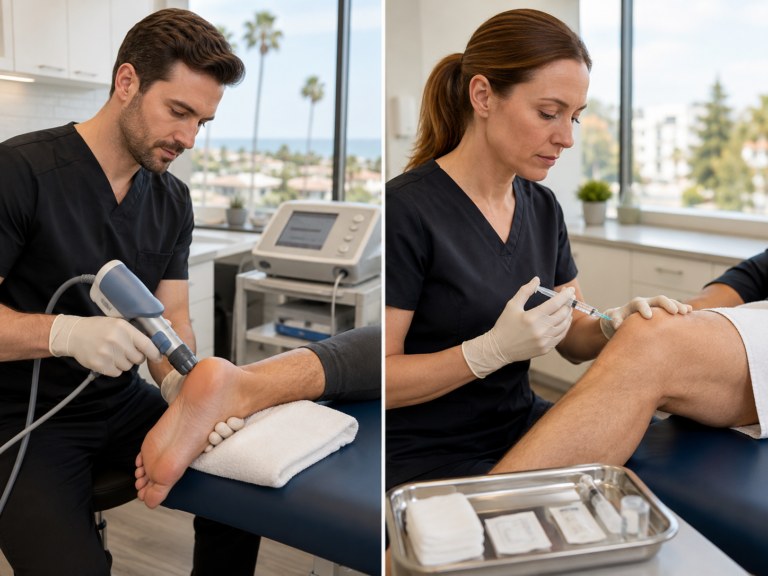
Understanding Shockwave Therapy
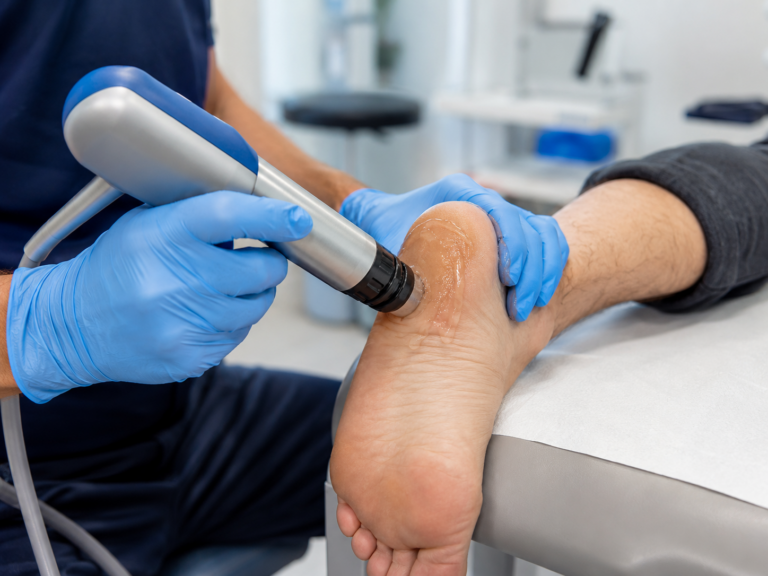
Shockwave therapy — clinically known as Extracorporeal Shock Wave Therapy (ESWT) — uses high-energy acoustic (sound) pressure waves delivered through a handheld applicator placed against the skin. There are no needles and no medication. The waves penetrate the targeted tissue, triggering microtrauma that “wakes up” a stalled healing response, increases local blood flow, stimulates collagen production, and helps break down calcified deposits and scar tissue.
How it works in practice: You lie back, the provider applies gel and moves the applicator over the painful area for roughly 5 to 15 minutes. Most patients describe a tapping or tolerable discomfort rather than sharp pain. Sessions are typically spaced about a week apart.
Typical costs (2026): Radial shockwave runs roughly $100–$300 per session, while focused shockwave (a more advanced, deeper-penetrating modality) ranges from $250–$500 per session. A full musculoskeletal course usually lands between $500 and $1,800, with most patients needing 3 to 6 sessions. Notably, as of January 2026 Medicare began covering ESWT for certain conditions, though many private insurers still classify it as elective. You can see a full local breakdown on our shockwave therapy cost in San Diego page.
Core benefits: Completely non-invasive, no downtime, no anesthesia, and a strong evidence base for chronic tendon and fascia conditions. Ideal use cases: plantar fasciitis, Achilles and patellar tendinopathy, tennis/golfer’s elbow, calcific shoulder tendinitis, and chronic heel pain. To understand the mechanism in more depth, see how shockwave therapy works.
Understanding Prolotherapy
Prolotherapy — short for “proliferation therapy” and also called regenerative injection therapy — works by injecting an irritant solution, most commonly a hypertonic dextrose (sugar) solution often combined with a local anesthetic, directly into damaged ligaments, tendon attachments, or joint spaces. The injected irritant provokes a brief, controlled inflammatory response, which is intended to recruit the body’s repair cells to strengthen and tighten loose or weakened connective tissue.
How it works in practice: A provider, often using ultrasound guidance for accuracy, delivers multiple injections (commonly 4 to 15 small shots) around the target area in a single visit. Because it relies on a deliberate inflammatory cycle, sessions are usually spaced 4 to 6 weeks apart over the course of several months.
Typical costs (2026): Prolotherapy commonly runs $150–$600 per session, with some complex or PRP-enhanced visits priced higher. Because a full plan often involves 4 to 6 sessions over 3 to 6 months, total course costs frequently land between $600 and $3,600. Prolotherapy is generally not covered by insurance and is considered self-pay by most payers.
Core benefits: It can target deep intra-articular joint structures and ligamentous laxity that surface-applied therapies cannot reach directly. Ideal use cases: joint instability, sacroiliac and low-back ligament pain, knee and shoulder laxity, and some forms of osteoarthritis-related pain. One important caveat: the clinical evidence for prolotherapy remains mixed and limited compared to shockwave therapy, so results can be less predictable.

| Attribute | Shockwave Therapy | Prolotherapy |
|---|---|---|
| Method | Non-invasive acoustic waves through skin | Needle injections of irritant solution |
| Needles / Pain | No needles; mild tapping sensation | Multiple injections; injection discomfort |
| Upfront Cost (per session) | $100–$500 | $150–$600 |
| Typical Full Course | $500–$1,800 (3–6 sessions) | $600–$3,600 (4–6 sessions) |
| Recovery / Downtime | None — resume activity same day | Mild soreness 1–3 days; controlled inflammation |
| Session Spacing | ~1 week apart | ~4–6 weeks apart |
| Time to Full Results | Weeks (often 4–12) | Several months |
| Evidence Strength | Strong for many tendon/fascia conditions | Mixed / limited |
| Best For | Tendinopathy, plantar fasciitis, calcific deposits | Joint/ligament instability, laxity, SI joint pain |
Pros and Cons Breakdown
Pros of Shockwave Therapy
- Completely non-invasive — no needles, no anesthesia, no incisions, so infection risk is minimal.
- Zero downtime — you can walk out and return to your San Diego routine immediately, even a beach walk.
- Stronger evidence base — well-studied and often first-line for chronic tendon and fascia problems.
- Shorter overall timeline — sessions are weekly, so a full course can wrap in about a month.
Cons of Shockwave Therapy
- Surface and depth limits — extremely deep intra-articular joint targets can be harder to reach than with a direct injection.
- Temporary discomfort — some patients find the higher-energy pulses uncomfortable, though intensity is adjustable. See does shockwave therapy hurt.
- Multiple visits required — it is rarely a one-and-done fix.
Pros of Prolotherapy
- Directly targets joint structures — injections can reach ligaments and intra-articular spaces precisely, often with ultrasound guidance.
- Useful for instability — a reasonable option when loose ligaments or joint laxity are the root problem.
- Stimulates connective-tissue repair — aims to strengthen the tissue, not just relieve symptoms.
Cons of Prolotherapy
- It involves needles — multiple injections per session can be a barrier for needle-averse patients.
- Post-injection soreness — the deliberate inflammatory response can cause a day or two of increased pain.
- Less predictable evidence — the research is mixed, so outcomes vary more widely than with shockwave.
- Longer timeline — with sessions weeks apart, full results can take several months.
Which Option Is Better? (The Ultimate Showdown)
The honest answer to the shockwave therapy vs prolotherapy question is that the better treatment depends on what is actually causing your pain — not which is “newer” or “better” in the abstract.
Choose shockwave therapy if your problem is a chronic tendon or fascia condition — plantar fasciitis, Achilles or patellar tendinopathy, tennis elbow, or calcific shoulder tendinitis — and especially if you want to avoid needles, avoid downtime, and prefer the treatment with the stronger published evidence. For the active San Diego lifestyle, where surfers, runners, and Padres-season weekend warriors don’t want to be sidelined, the no-downtime nature of shockwave is a major practical advantage. On a pure cost-versus-benefit basis, shockwave also tends to deliver a shorter, more predictable treatment arc, with total course costs often lower than a full prolotherapy plan.
Choose prolotherapy if your core problem is diagnosed joint or ligament instability/laxity — for example sacroiliac joint pain or a chronically loose joint — where the value of placing the regenerative agent directly into the structure outweighs the downsides of needles and a longer timeline, and you’re comfortable with a less certain evidence base.
For the largest share of patients searching for soft-tissue pain relief in San Diego — heel pain, tendon pain, and overuse injuries — shockwave therapy is the stronger default first choice, with prolotherapy reserved as a more specialized, injection-based option for specific instability cases. If you’re weighing this against standard rehab, our shockwave vs physical therapy comparison is a helpful next read.
Conclusion & Recommendation
When comparing shockwave therapy vs prolotherapy, the practical takeaway is straightforward: shockwave therapy is the better starting point for the majority of chronic tendon, fascia, and overuse pain conditions thanks to its non-invasive, needle-free, no-downtime profile and stronger evidence base, while prolotherapy is a more specialized injection-based option best suited to documented joint or ligament instability. The smartest move isn’t to pick a treatment from an article — it’s to get an accurate diagnosis first, then match the treatment to the actual cause of your pain.
Ready to Find Out If Shockwave Therapy Is Right for You?
If you’re a San Diego resident living with stubborn heel, tendon, or joint pain, the best next step is a personalized evaluation. Our team can confirm whether shockwave therapy fits your condition and goals — and tell you honestly if it doesn’t. Learn more about the treatment on our What Is Shockwave Therapy page, or review our shockwave therapy benefits guide, then reach out to schedule a consultation at our San Diego clinic. No pressure — just clear, expert guidance toward the option that actually gets you back to the life you love under the Southern California sun.
Frequently Asked Questions
1. Is shockwave therapy better than prolotherapy?
1. Is shockwave therapy better than prolotherapy?
For most chronic tendon and fascia conditions — like plantar fasciitis and tendinopathy — shockwave therapy is generally the stronger first choice because it is non-invasive, needle-free, and backed by more robust clinical evidence. Prolotherapy can be the better option specifically for joint or ligament instability where a direct injection is warranted.
2. Which is more painful, shockwave therapy or prolotherapy?
2. Which is more painful, shockwave therapy or prolotherapy?
Prolotherapy involves multiple needle injections and often a day or two of post-injection soreness, while shockwave therapy is needle-free and usually feels like a tolerable tapping sensation that can be dialed up or down for comfort.
3. How much does shockwave therapy cost in San Diego compared to prolotherapy?
3. How much does shockwave therapy cost in San Diego compared to prolotherapy?
In 2026, shockwave therapy typically runs $100–$500 per session ($500–$1,800 for a full course), while prolotherapy runs about $150–$600 per session ($600–$3,600 for a full course). Final pricing depends on your condition and the number of sessions needed.
4. Does insurance cover shockwave therapy or prolotherapy?
4. Does insurance cover shockwave therapy or prolotherapy?
Prolotherapy is generally considered self-pay and rarely covered. Shockwave therapy has historically been out-of-pocket too, though Medicare began covering ESWT for certain conditions as of January 2026. Always confirm coverage directly with your insurer.
5. How long does it take to see results from each treatment?
5. How long does it take to see results from each treatment?
Shockwave therapy results often appear within a few weeks, with sessions spaced about a week apart. Prolotherapy works over a longer arc — sessions are typically 4 to 6 weeks apart and full results can take several months.
6. Can I combine shockwave therapy and prolotherapy?
6. Can I combine shockwave therapy and prolotherapy?
In some cases providers may use complementary approaches, but this should only be done under the guidance of a qualified clinician who has evaluated your specific diagnosis. Combining treatments without a clear plan can muddy results.
7. Is there any downtime with shockwave therapy?
7. Is there any downtime with shockwave therapy?
No. One of shockwave therapy’s biggest advantages is that there’s essentially no downtime — most San Diego patients return to normal daily activity, including light exercise, the same day.
8. Which treatment is better for plantar fasciitis?
8. Which treatment is better for plantar fasciitis?
Shockwave therapy is one of the most well-supported non-surgical options for chronic plantar fasciitis. See our dedicated plantar fasciitis treatment in San Diego guide for specifics.
9. How do I know which treatment is right for me?
9. How do I know which treatment is right for me?
It comes down to your diagnosis. Soft-tissue and tendon problems usually point toward shockwave therapy; documented joint or ligament instability may point toward prolotherapy. A professional evaluation is the only reliable way to decide.