
Shockwave Therapy in Carlsbad, California
If chronic pain in your heel, elbow, shoulder, hip, or knee keeps interrupting your training, your work, or simply your day-to-day life, you’ve probably been told to “rest it” more times than you can count. Shockwave therapy Carlsbad is a non-surgical, drug-free treatment that uses focused acoustic pressure waves to stimulate the body’s natural healing response in injured tendons, ligaments, and other soft tissue — and it’s designed for exactly the kind of stubborn, lingering pain that hasn’t fully responded to rest and standard care. At San Diego Shockwave Therapy Center in Carlsbad, we focus on helping active adults find relief and get back to moving comfortably.
Why Shockwave Therapy Matters for Carlsbad Patients
Soft-tissue pain has a way of quietly reshaping your life. A nagging Achilles tendon turns a morning run into a careful hobble. Plantar fasciitis makes the first few steps out of bed something you brace for. Tennis elbow makes lifting a coffee mug or shaking a hand a small ordeal. None of these problems are dramatic on their own, but together they chip away at the things that make daily life feel normal — exercise, work, sleep, and time with family.
Many people try the obvious first steps: rest, ice, over-the-counter anti-inflammatories, maybe a brace or new shoes. Those measures can absolutely help, and they’re often the right place to start. But tendon and connective-tissue injuries are notoriously slow to heal because these tissues have a limited blood supply. When pain persists for weeks or months, it isn’t a sign that you’re doing something wrong — it’s often just the nature of the tissue involved.
That’s where a proper evaluation matters. Getting an accurate picture of what is causing your pain, and how long it’s been going on, helps determine whether a treatment like shockwave therapy is a reasonable option for you. The benefit of seeking care isn’t only pain relief; it’s avoiding the trap of waiting indefinitely for something to resolve on its own while your mobility and confidence slowly shrink. If you’re not sure where your symptoms fall, learning what shockwave therapy is is a sensible starting point before committing to anything.

Conditions and Symptoms Shockwave Therapy May Help
Shockwave therapy — clinically known as extracorporeal shockwave therapy, or ESWT — is most often used for chronic soft-tissue and tendon-related conditions. Patients in Carlsbad and the wider San Diego area commonly seek care for:
- Plantar fasciitis — persistent heel and arch pain, especially with the first steps in the morning. This is one of the most studied applications of shockwave therapy.
- Achilles tendinopathy — pain, stiffness, or thickening along the Achilles tendon, common in runners and active adults.
- Tennis elbow (lateral epicondylitis) — pain on the outer elbow that worsens with gripping or lifting.
- Jumper’s knee (patellar tendinopathy) — pain just below the kneecap, frequently seen in athletes who jump or change direction often.
- Hip pain related to gluteal tendinopathy or greater trochanteric pain.
- Shoulder tendinopathy, including calcific tendinopathy of the rotator cuff.
- Chronic soft-tissue and sports-related overuse injuries that haven’t fully resolved with rest and conventional care.
A few honest caveats: shockwave therapy is generally considered for chronic cases — pain that has been present for several weeks or longer — rather than fresh, acute injuries. It also isn’t appropriate for everyone or every diagnosis. Symptoms like numbness, sudden severe pain, signs of infection, or pain following a significant trauma deserve prompt medical evaluation rather than self-directed treatment. If your pain is specifically in the knee or heel, our focused guides on knee pain treatment and shockwave therapy for plantar fasciitis walk through those conditions in more detail.
How Shockwave Therapy Works
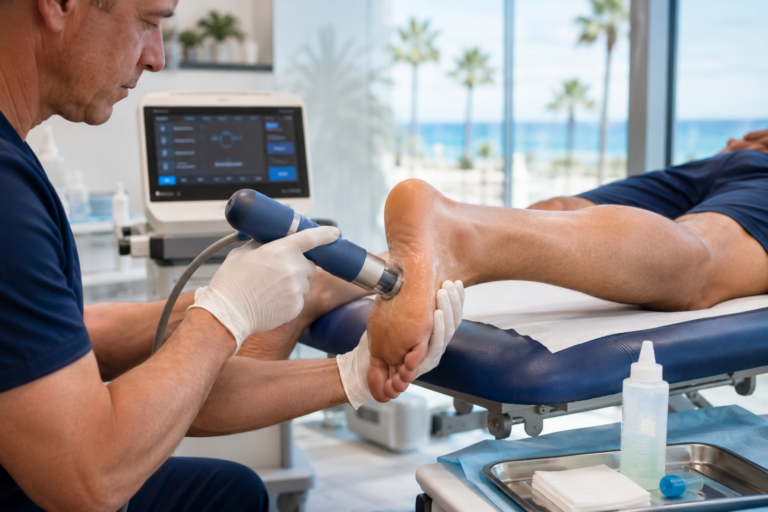
The name sounds intense, but the treatment itself is straightforward and non-invasive. Shockwave therapy delivers high-energy acoustic pressure waves to a targeted area of the body through a handheld applicator placed against the skin. These pressure waves are mechanical, not electrical, and they’re thought to work by stimulating local circulation, prompting a controlled healing response, and influencing how the body processes pain in the treated tissue. You can read a deeper breakdown of how shockwave therapy works if you want the mechanics in full.
Before your session, the clinician reviews your history and examines the area to confirm shockwave therapy is appropriate and to locate the precise point of treatment. A gel is applied to the skin to help transmit the acoustic waves efficiently.
During your session, the applicator delivers a series of pulses to the targeted area. Most sessions are brief — often in the range of several minutes per area — and no anesthesia is required. Some patients feel a tapping or mild discomfort during treatment, particularly over sensitive spots, and the intensity can usually be adjusted for comfort. If you’re nervous about discomfort, our honest take on whether shockwave therapy hurts covers what to expect.
After your session, you can typically return to your normal day right away. There’s no incision, no stitches, and no downtime in the surgical sense. You may be advised to ease off high-intensity loading of the treated area for a short period so the tissue can respond. Mild soreness or temporary tenderness afterward is common and usually settles on its own.

Treatment Outcomes and What Patients Can Expect
Honest expectations are part of responsible care, so here’s the balanced picture: shockwave therapy may help reduce pain and support function for the right candidates, but it is not a guaranteed cure, and results vary from person to person.
Most treatment plans involve a series of sessions rather than a single visit — commonly spaced about a week apart — because the goal is to gradually stimulate tissue healing over time. Many patients don’t notice the full effect immediately; improvement often unfolds over the weeks following the treatment course as the tissue responds. Some people experience meaningful relief, some experience partial improvement, and others may need to explore additional or alternative approaches. The number of sessions you may need depends on your specific condition and how you respond, which we explain further in our guide on how many sessions you may need.
Factors that can influence outcomes include the underlying diagnosis, how long the condition has been present, your overall health, activity level, and how closely you follow any recommended guidance between sessions. Combining shockwave therapy with appropriate loading exercises or rehabilitation often makes sense, and our overview of shockwave vs physical therapy explains how the two can complement each other. For a realistic sense of the days and weeks after treatment, see our notes on recovery basics.
How Shockwave Therapy Compares to Other Treatment Options
Patients researching chronic tendon and soft-tissue pain often weigh several approaches at once. The table below offers a general, side-by-side comparison to help you understand where shockwave therapy fits. It is for educational purposes only — the right option for you depends on your diagnosis and an individual evaluation.
| Factor | Shockwave Therapy (ESWT) | Rest, Medication & Home Care | Corticosteroid Injection | Surgery |
|---|---|---|---|---|
| Invasiveness | Non-invasive (applied to the skin) | Non-invasive | Minimally invasive (injection) | Invasive (incision) |
| Anesthesia | Not required | Not required | Usually local | General or regional |
| Typical downtime | Little to none; mild temporary soreness possible | None | Short | Days to weeks of recovery |
| Number of visits | Often a short series of sessions | Ongoing self-care | One or a limited number | Procedure plus rehab |
| Best suited for | Chronic tendon/soft-tissue pain that hasn’t resolved with conservative care | Early or mild symptoms | Certain inflammatory conditions | Cases not responding to non-surgical options |
| Drug-free? | Yes | Often involves anti-inflammatories | No | Involves medication |
| Key considerations | Results vary; improvement often gradual over weeks | May be slow for tendon injuries | May not be suitable for repeated long-term use | Higher risk and recovery commitment |
A common pattern is to start with conservative care, consider a non-invasive option like shockwave therapy if symptoms persist, and reserve more invasive procedures for cases that don’t respond. Where you fall on that spectrum is exactly the kind of thing we’ll talk through during your consultation, and our overview of shockwave vs physical therapy is a useful companion read.
Our Patient Care Process
We keep the process clear and personalized from the first contact to follow-up:
- Initial consultation. We listen to your concerns, your goals, and what you’ve already tried.
- Medical history and symptom review. We discuss how long you’ve had symptoms, what makes them better or worse, and any relevant health background.
- Physical exam or diagnostic review. We examine the affected area to understand the problem and confirm whether shockwave therapy is a reasonable option for you.
- Personalized treatment planning. Based on your evaluation, we outline a plan, including how many sessions may be appropriate and what to expect.
- Treatment. Sessions are performed in our Carlsbad clinic using a handheld applicator, with comfort adjustments as needed.
- Follow-up care. We check in on your response and adjust the plan when it makes sense to do so.
- Progress tracking. We monitor how your pain and function change across the treatment course so decisions are based on how you are actually responding.
Knowing when to start treatment is a common question, and it’s something we’ll talk through directly during your consultation rather than rushing into a plan.
Why Choose San Diego Shockwave Therapy Center
San Diego Shockwave Therapy Center is a Carlsbad clinic focused specifically on shockwave (ESWT) treatment for soft-tissue and tendon-related pain. That focus matters — it means the care you receive is centered on evaluating whether this treatment fits your situation and delivering it thoughtfully, rather than treating it as an afterthought.
What patients can expect from us is patient-centered, compassionate care: time to ask questions, a clear explanation of your options, and honest guidance about whether shockwave therapy is right for you. We believe good treatment starts with good communication, and we’d rather tell you plainly when something isn’t a fit than oversell a result. Our convenient Carlsbad location on Gateway Road also makes it practical to keep up with a full treatment course without a long drive. If you’re weighing your options, our safety guide is a useful read.
Serving Carlsbad and the San Diego Area
Carlsbad is an active community — coastal trails, cycling routes, surfing, youth and adult sports leagues, gym culture, and plenty of people whose work keeps them on their feet or at a desk for long hours. All of that activity is great for health, but it also produces exactly the kind of repetitive-strain and overuse injuries that shockwave therapy is often used to address. From weekend runners managing heel pain to desk workers dealing with shoulder tendinopathy, the patients we see reflect how people in this area actually live and move.
Our clinic is located in the Bressi Ranch / Gateway Road area of Carlsbad, making it accessible for residents across the city and convenient for patients traveling from greater San Diego. If you’ve been searching for shockwave therapy San Diego patients can reach without a major commute, our Carlsbad location is positioned to serve North County and the broader region. Wherever you’re coming from, the priority is the same: an individualized evaluation and a treatment plan that fits your life.
Cost, Insurance, and Payment Expectations
Cost is a fair question to ask up front, and we aim to be transparent about it. Individual shockwave therapy sessions at our clinic typically start around $75, with package options available that offer meaningful savings for patients who need a full treatment course. Many patients find that when compared with the long-term costs of ongoing medications, repeated injections, or surgery — including the recovery time surgery requires — shockwave therapy can be a cost-effective option.
That said, the right plan and the total cost depend on several factors, including:
- The specific condition being treated
- Findings from your consultation and exam
- Any diagnostic needs
- The number of treatment sessions recommended
- The type of treatment plan
- Insurance coverage and whether the service is self-pay or covered
- Any follow-up care
Because every situation is different, we’ll provide a detailed, personalized cost estimate during your consultation so there are no surprises. For more context, our page on shockwave therapy cost breaks down typical pricing considerations.
Medical References
For patients who want to read more about the clinical background of this treatment, extracorporeal shockwave therapy is covered in clinical reference resources such as Physio-pedia’s overview of Extracorporeal Shockwave Therapy.
This page is for general educational purposes and is not a substitute for individual medical advice. A diagnosis and any treatment recommendation always depend on a personal evaluation.
Ready to Talk About Your Pain? Book a Consultation in Carlsbad
If chronic heel, tendon, joint, or soft-tissue pain has been holding you back, you don’t have to keep guessing whether shockwave therapy Carlsbad is right for you. The clearest next step is a consultation, where we can evaluate your situation, answer your questions honestly, and outline a personalized plan with a transparent cost estimate.
Call San Diego Shockwave Therapy Center today at (760) 477-4760 to schedule your consultation at our Carlsbad clinic on Gateway Road. Let’s figure out, together, whether this non-surgical option can help you get back to moving comfortably.
Frequently Asked Questions
1. What is shockwave therapy used for in Carlsbad?
1. What is shockwave therapy used for in Carlsbad?
Shockwave therapy is a non-surgical treatment used primarily for chronic soft-tissue and tendon conditions. In Carlsbad, patients commonly seek it for plantar fasciitis, Achilles tendinopathy, tennis elbow, jumper’s knee, hip pain, and shoulder tendinopathy. It’s generally considered for pain that has persisted for several weeks or longer and hasn’t fully responded to rest and standard care. An individual evaluation determines whether it’s appropriate for your specific condition.
2. Does shockwave therapy hurt?
2. Does shockwave therapy hurt?
Most patients tolerate shockwave therapy well. During treatment you may feel a tapping sensation or mild discomfort, especially over tender areas, and the intensity can usually be adjusted for comfort. No anesthesia is needed, and sessions are brief. Some people notice mild, temporary soreness afterward that typically settles on its own. Comfort levels vary from person to person, and your clinician will work with you throughout the session.
3. How many shockwave therapy sessions will I need?
3. How many shockwave therapy sessions will I need?
There’s no single answer, because it depends on your condition, how long you’ve had it, and how you respond. Many treatment plans involve a series of sessions spaced roughly a week apart rather than a single visit. We’ll recommend a plan after evaluating you and will adjust it based on your progress. Results vary, so the plan is always tailored to the individual rather than applied as a fixed formula.
4. How much does shockwave therapy cost in Carlsbad?
4. How much does shockwave therapy cost in Carlsbad?
Individual sessions at our clinic typically start around $75, with package options that offer savings for a full treatment course. The total cost depends on your condition, the number of sessions recommended, and your treatment plan. Many patients find it cost-effective compared with the long-term costs of medications, repeated injections, or surgery. We provide a detailed, personalized estimate during your consultation so you know what to expect.
5. Is shockwave therapy covered by insurance?
5. Is shockwave therapy covered by insurance?
Insurance coverage for shockwave therapy varies by plan and condition, and some patients pay out of pocket. Because coverage differs so much from one situation to the next, the best approach is to discuss your specific plan with us during your consultation. We aim to be transparent about pricing and will provide a clear cost estimate so you can make an informed decision before beginning any treatment course.
6. How long does a shockwave therapy session take?
6. How long does a shockwave therapy session take?
Sessions are generally brief, often just several minutes of active treatment per area, though your total visit includes time for assessment and setup. Because the treatment is non-invasive and requires no anesthesia, most patients can return to their normal day right away. The exact length depends on how many areas are being treated and your individual treatment plan.
7. Is shockwave therapy safe?
7. Is shockwave therapy safe?
For appropriate candidates, shockwave therapy is widely used and considered non-invasive, with no incisions or downtime in the surgical sense. As with any treatment, it isn’t right for everyone or every diagnosis, and certain conditions or situations may make it unsuitable. That’s why a proper evaluation comes first. Mild, temporary soreness afterward is common. Our team will review your history to confirm whether it’s a safe option for you.
8. How soon will I see results from shockwave therapy?
8. How soon will I see results from shockwave therapy?
Improvement often unfolds gradually over the weeks following a treatment course rather than immediately after a single session. Some patients notice changes sooner, others later, and results vary based on the condition, its duration, and individual factors. Because tendon and soft-tissue healing takes time, patience is part of the process. We track your progress across sessions so the plan reflects how you’re actually responding.
9. Who is a good candidate for shockwave therapy?
9. Who is a good candidate for shockwave therapy?
Good candidates are typically adults with chronic soft-tissue or tendon-related pain — such as plantar fasciitis, Achilles tendinopathy, or tennis elbow — that hasn’t fully resolved with rest and conventional care. It’s generally not used for fresh, acute injuries, and certain health conditions may make it unsuitable. The only reliable way to know if you’re a candidate is an individual evaluation, which is exactly what your consultation is for.
10. Is shockwave therapy a substitute for surgery?
10. Is shockwave therapy a substitute for surgery?
Shockwave therapy is a non-surgical option that some patients explore before considering more invasive procedures, but it isn’t a guaranteed alternative to surgery for every condition. Whether it’s appropriate depends on your diagnosis and how your body responds. For some people it may reduce pain and support function; for others, additional or different treatment may be needed. We’ll give you honest guidance based on your specific situation.
11. Can I exercise after a shockwave therapy session?
11. Can I exercise after a shockwave therapy session?
You can usually resume normal daily activity right after a session, but you may be advised to ease off high-intensity loading of the treated area for a short period so the tissue can respond. The specific guidance depends on your condition and activity level. Combining treatment with appropriate rehabilitation or loading exercises often makes sense, and we’ll give you tailored recommendations during your care.
12. Where is your shockwave therapy clinic located?
12. Where is your shockwave therapy clinic located?
San Diego Shockwave Therapy Center is located at 2623 Gateway Rd #104, Carlsbad, CA 92009, in the Gateway Road / Bressi Ranch area. Our location is convenient for patients across Carlsbad and accessible for those traveling from greater San Diego and North County. We’re open Monday through Friday from 10 a.m. to 6 p.m. and Saturday from 10 a.m. to 4 p.m. Call (760) 477-4760 to schedule.
13. Do I need a referral to get shockwave therapy?
13. Do I need a referral to get shockwave therapy?
Requirements can depend on your insurance and individual circumstances. Many patients reach out directly to schedule a consultation, where we evaluate your condition and determine whether shockwave therapy is appropriate. If you have questions about referrals or what your plan requires, contact our Carlsbad office and we’ll help you understand the next steps before you commit to a treatment plan.