
Shockwave Therapy Cost Guide: San Diego & Carlsbad Pricing Explained
If you are researching prices before booking treatment, this Shockwave Therapy Cost Guide San Diego is built to give you straight answers. At San Diego Shockwave Therapy Center in Carlsbad, we believe patients deserve to understand what they are paying for, why costs vary, and how shockwave therapy compares to other options for chronic soft-tissue pain. Below, you will find transparent pricing context, the factors that influence your total cost, and practical guidance on getting a personalized estimate.
Shockwave therapy — also called extracorporeal shockwave therapy (ESWT) — is a non-surgical treatment that uses acoustic pressure waves to support the body’s natural healing response in tendons and other soft tissues. For people dealing with conditions like plantar fasciitis, Achilles tendon pain, tennis elbow, jumper’s knee, hip pain, or shoulder tendinopathy, it can be an appealing alternative to medications, repeated injections, or surgery. Cost is often one of the first questions patients ask, and it is a fair one.
Why Understanding Shockwave Therapy Cost Matters
When you are living with persistent pain, the financial side of care is rarely a small detail. Many patients in San Diego and Carlsbad have already spent money on shoe inserts, over-the-counter anti-inflammatories, physical therapy visits, or cortisone injections before they consider shockwave therapy. By the time they reach our clinic, they want to know whether this option is worth it — and what the realistic out-of-pocket commitment looks like.
Cost transparency matters because it lets you plan. Shockwave therapy is typically delivered as a short series of sessions rather than a single visit, so the price of one appointment does not tell the whole story. Understanding the likely number of sessions, the savings available through packages, and how the total compares to longer-term alternatives helps you make a confident, informed decision instead of a rushed one.
It also matters because price and value are not the same thing. A lower per-session rate is not always the best deal if it does not include a proper evaluation or a treatment plan suited to your condition. Throughout this guide, we focus on helping you weigh both. If you are price-sensitive, you may also want to read our overview of more affordable shockwave therapy options in San Diego alongside this page.
Conditions and Symptoms Shockwave Therapy May Help
Shockwave therapy is most commonly used for chronic tendon and soft-tissue conditions that have not responded well to rest and conservative care. It is not the right answer for every type of pain, which is why an individual evaluation is essential. The table below outlines conditions patients often ask about and the symptoms that tend to prompt that search.
| Condition | Common Symptoms Patients Describe | Where It Hurts |
|---|---|---|
| Plantar fasciitis | Sharp heel pain, worse with first steps in the morning | Bottom of the heel and arch |
| Achilles tendinopathy | Stiffness and aching along the tendon, especially after activity | Back of the ankle/lower calf |
| Tennis elbow (lateral epicondylitis) | Pain gripping, lifting, or twisting | Outer elbow |
| Jumper’s knee (patellar tendinopathy) | Pain below the kneecap during jumping or squatting | Front of the knee |
| Hip tendinopathy / greater trochanteric pain | Aching on the outer hip, worse lying on that side | Outer hip |
| Shoulder tendinopathy / calcific tendinitis | Pain raising the arm, night discomfort | Shoulder |
| Sports-related overuse injuries | Lingering soreness that limits training or performance | Varies |
These are examples, not a diagnosis. Many of these conditions share symptoms with other problems, so what feels like one issue may turn out to be another on examination. To learn more about how the treatment addresses a specific issue, our dedicated page on shockwave therapy for plantar fasciitis in San Diego walks through that condition in detail.
How Shockwave Therapy Works
Understanding the process helps explain why cost is structured the way it is. Extracorporeal shockwave therapy delivers focused or radial acoustic pressure waves to the affected area through the skin. According to clinical resources such as Physiopedia’s overview of extracorporeal shockwave therapy, these waves are thought to stimulate localized healing activity, support blood flow to the tissue, and influence how the area processes pain signals.
In practical terms, a session usually looks like this:
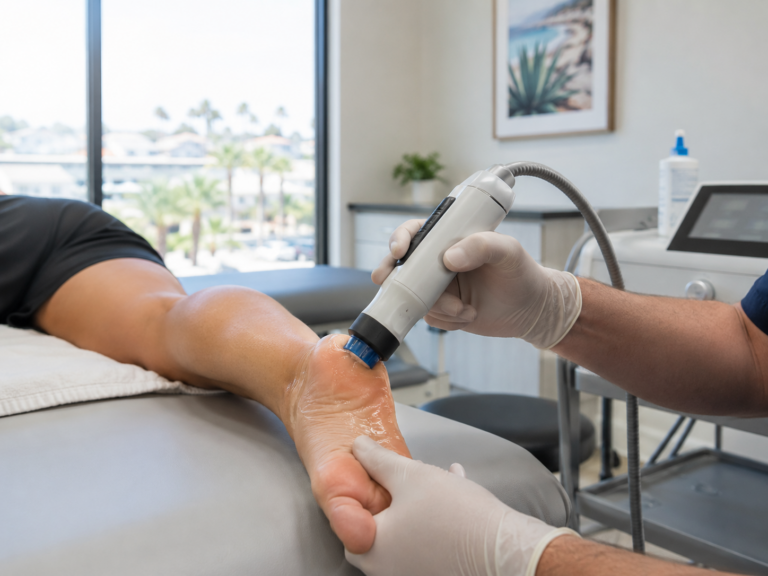
Before treatment, your clinician reviews your history, examines the area, and confirms shockwave therapy is appropriate for you. During treatment, a gel is applied to the skin and a handheld device delivers a series of pulses to the target tissue for several minutes. Most patients describe a tapping or tolerable discomfort rather than sharp pain, though sensitivity varies — a question we cover on our page about whether shockwave therapy hurts. After treatment, there is generally no downtime; you can usually return to your day, with simple guidance on activity. For a fuller explanation of the mechanism, see how shockwave therapy works.
Because results build gradually as the tissue responds, shockwave therapy is typically delivered as a course of sessions spaced about a week apart. That session structure is the single biggest driver of total cost — which is why the number of sessions matters so much to your budget.
Shockwave Therapy Cost in San Diego: What to Expect
Here is the part you came for. Shockwave therapy costs vary based on the condition being treated and the number of sessions required. At San Diego Shockwave Therapy Center, individual sessions typically start from $75+, and package deals offer significant savings compared with paying session by session.
We keep our pricing transparent and provide a detailed cost estimate during your consultation, once we understand your condition and how many sessions are likely appropriate. We avoid quoting a single flat number online because doing so would be misleading — the right plan for a stubborn case of Achilles tendinopathy may differ from the plan for early-stage tennis elbow.

Several factors influence your total cost:
- Your condition and its severity — more established or complex cases may need more sessions.
- The number of sessions in your recommended course, which is confirmed after evaluation.
- Whether you choose single sessions or a package, since packages are priced to reward a full course.
- Any diagnostic or follow-up needs identified during your visits.
It is worth putting price in context. When compared to the long-term costs of medications, repeated injections, or surgery — including recovery time and missed work — most patients find shockwave therapy to be cost-effective. For a deeper breakdown of fees, our shockwave therapy cost page for San Diego complements this guide, and our resource on how many shockwave sessions you may need helps you estimate the total before you commit.
How Shockwave Therapy Compares on Value
Patients weighing cost almost always compare shockwave therapy to the alternatives they have already tried or been offered. Each option carries its own price tag, time commitment, and trade-offs. If you are still deciding which route fits your situation and budget, these comparisons may help:
- Shockwave therapy vs. cortisone injections, which weighs a non-invasive course against repeated injections.
- Shockwave therapy vs. surgery, for patients considering whether a non-surgical step makes sense first.
- Shockwave therapy vs. physical therapy, since the two are often used together rather than as either/or.
- Shockwave therapy vs. PRP and vs. stem cell therapy, for those exploring regenerative options.
These pages are educational, not a substitute for an evaluation. The most cost-effective choice depends on your diagnosis, goals, and how your tissue has responded to past care.
Treatment Outcomes and What Patients Can Expect
It is important to set realistic expectations. Shockwave therapy may help reduce pain and support function for many soft-tissue conditions, but results vary from person to person, and no treatment can guarantee a specific outcome. Some patients notice changes within a few weeks; for others, improvement continues to develop after the course is complete as the tissue keeps responding.
Several factors can influence results, including how long the condition has been present, your overall health, activity levels, and how closely you follow your clinician’s guidance between sessions. Shockwave therapy is also frequently used alongside, not instead of, a loading or rehabilitation program — which is one reason our comparison of shockwave therapy and physical therapy is one of our most-read resources.
We will discuss likely timelines and what improvement could look like for your specific condition during your consultation, and we track your progress across visits so the plan can be adjusted as needed. Patients who want to understand safety and candidacy in more depth can review our shockwave therapy safety guide.
Our Patient Care Process
We keep our process clear and consistent so you always know what comes next:
- Initial consultation — we listen to your goals and concerns and answer your cost questions up front.
- Medical history and symptom review — we look at how long you have had symptoms and what you have already tried.
- Physical examination — we assess the affected area to confirm shockwave therapy is appropriate for you.
- Personalized treatment planning — we recommend a session course and provide a detailed, written cost estimate.
- Treatment — sessions are delivered in the clinic, typically spaced about a week apart.
- Follow-up care — we check in on your response and coordinate any complementary care.
- Progress tracking — we monitor changes across the course so your plan stays matched to your progress.
Diagnosis and treatment recommendations always depend on an individual evaluation, so this process is designed to tailor care — and cost — to you rather than to a one-size-fits-all template.
Why Choose San Diego Shockwave Therapy Center

Patients across Carlsbad and San Diego choose us because we combine focused expertise with honest communication about cost and expectations. Shockwave therapy is what we do, so our clinical attention stays on getting your treatment plan right rather than treating it as an afterthought to an unrelated service.
We are committed to transparent pricing, a thorough evaluation before any plan is recommended, and a patient-centered approach that respects both your time and your budget. We use modern shockwave technology and take the time to explain your options in plain language. You can read more about what patients value in our care on our shockwave therapy reviews page, and if you are comparing providers, our guide to choosing the best shockwave therapy clinic in San Diego outlines what to look for.
Serving Carlsbad and San Diego
Our clinic is located at 2623 Gateway Rd #104, Carlsbad, CA 92009, making us convenient for patients throughout north San Diego County and the greater San Diego area. Carlsbad’s active, outdoor-focused lifestyle — running along the coast, surfing, golf, youth and adult sports, and long hours on your feet at work — means soft-tissue overuse injuries are common here. Plantar fasciitis and Achilles pain, in particular, show up often among people who stay active.
Because we sit close to major routes, patients commuting from across San Diego can reach us without a long detour from their day. If you are weighing local options or trying to decide when to start shockwave therapy, our team is happy to talk through what makes sense for your schedule and your condition.
Cost, Insurance, and Payment Expectations
Because shockwave therapy for tendinopathy is frequently considered elective, coverage varies and is not guaranteed. Many patients pay out of pocket, and we keep self-pay pricing transparent for exactly that reason. Your final cost depends on your condition, our consultation findings, any diagnostic needs, the number of treatments recommended, and whether you choose single sessions or a package.
If you have an HSA or FSA, you may be able to use those funds toward treatment, though you should confirm eligibility with your plan administrator. We do not make assumptions about your specific insurance benefits; instead, the clinic can provide a personalized estimate after your evaluation so there are no surprises. Our goal is for you to know your expected investment before you begin.
Ready to Get a Clear Cost Estimate?
You should not have to guess what your care will cost. At San Diego Shockwave Therapy Center, we make your shockwave therapy cost in San Diego transparent from the start — with an honest evaluation, a recommended session plan, and a written estimate before you commit. If you are dealing with plantar fasciitis, Achilles pain, tennis elbow, or another stubborn soft-tissue injury, a non-surgical option may be worth exploring.
Call us today at +1 (760) 477-4760 to schedule your consultation at our Carlsbad clinic and get a personalized cost estimate. Take the first step toward understanding your options and moving forward with confidence.
Frequently Asked Questions
1. How much does shockwave therapy cost in San Diego?
1. How much does shockwave therapy cost in San Diego?
Shockwave therapy cost in San Diego varies based on the condition being treated and the number of sessions required. At San Diego Shockwave Therapy Center in Carlsbad, individual sessions typically start from $75+, with package deals offering meaningful savings over paying session by session. Because the right number of sessions depends on your specific condition, we provide a detailed, personalized cost estimate during your consultation rather than a single flat price.
2. Why is shockwave therapy priced per session?
2. Why is shockwave therapy priced per session?
Shockwave therapy works gradually as the treated tissue responds, so it is usually delivered as a short course of sessions spaced about a week apart rather than a single visit. Pricing reflects that structure. The total depends on how many sessions your condition is likely to need, which is why packages exist — they bundle a full course at a lower effective rate than booking individually.
3. Is shockwave therapy cheaper than surgery or injections?
3. Is shockwave therapy cheaper than surgery or injections?
Many patients find shockwave therapy cost-effective when compared to the long-term costs of medications, repeated injections, or surgery, especially once recovery time and missed work are factored in. It is non-surgical and generally requires no downtime. Whether it is the better value for you depends on your diagnosis, so reviewing our shockwave versus surgery and versus cortisone comparisons alongside an evaluation is the best way to decide.
4. Does insurance cover shockwave therapy in Carlsbad?
4. Does insurance cover shockwave therapy in Carlsbad?
Coverage varies because shockwave therapy for tendinopathy is often considered elective, so it is not guaranteed. Many patients pay out of pocket, and we keep self-pay pricing transparent for that reason. Some patients use HSA or FSA funds, but you should confirm eligibility with your plan administrator. We can provide a personalized estimate after your evaluation so you know your expected cost before starting.
5. How many shockwave therapy sessions will I need?
5. How many shockwave therapy sessions will I need?
The number of sessions depends on your condition, how long you have had symptoms, and how your tissue responds. Many courses involve a handful of sessions spaced roughly a week apart, but your exact plan is confirmed after an evaluation. Our guide on how many shockwave sessions you may need explains the typical range in more detail, and we review your progress as treatment continues.
6. What conditions can shockwave therapy help with?
6. What conditions can shockwave therapy help with?
Shockwave therapy is commonly used for chronic soft-tissue and tendon conditions such as plantar fasciitis, Achilles tendinopathy, tennis elbow, jumper’s knee, hip tendinopathy, shoulder tendinopathy, and sports-related overuse injuries. It may help reduce pain and support function, though results vary. It is not appropriate for every type of pain, which is why an individual evaluation is essential before treatment.
7. Does shockwave therapy hurt?
7. Does shockwave therapy hurt?
Most patients describe shockwave therapy as a tapping sensation or tolerable discomfort rather than sharp pain, but sensitivity varies from person to person and depends on the area being treated. Settings can often be adjusted for comfort. Our dedicated page on whether shockwave therapy hurts covers what to expect in more detail so you can feel prepared before your first session.
8. Is there any downtime after shockwave therapy?
8. Is there any downtime after shockwave therapy?
Generally, there is no required downtime after a shockwave therapy session, and most patients return to their normal day. Your clinician may give simple activity guidance for the period between sessions to support your results. Because individual circumstances differ, any specific restrictions will be discussed during your visit based on your condition and treatment plan.
9. How soon will I see results from shockwave therapy?
9. How soon will I see results from shockwave therapy?
Some patients notice changes within a few weeks, while for others improvement continues to develop after the full course is complete. Results vary based on factors like how long the condition has been present, your overall health, and how closely you follow guidance between sessions. We will discuss realistic timelines for your specific condition and track your progress across visits.
10. Is shockwave therapy safe?
10. Is shockwave therapy safe?
Shockwave therapy is widely used as a non-surgical option for soft-tissue conditions and is generally well tolerated. As with any treatment, suitability depends on your individual health and condition, and certain situations may make it inappropriate. That is why we evaluate every patient before recommending care. Our shockwave therapy safety guide covers candidacy and common questions in greater depth.
11. Can I use HSA or FSA funds for shockwave therapy?
11. Can I use HSA or FSA funds for shockwave therapy?
Many patients are able to use HSA or FSA funds toward shockwave therapy, but eligibility depends on your specific plan. We recommend confirming with your plan administrator before booking. We keep self-pay pricing transparent so you can plan accordingly, and we provide a written cost estimate after your evaluation to make budgeting straightforward.
12. Do you serve patients outside of Carlsbad?
12. Do you serve patients outside of Carlsbad?
Yes. Our clinic at 2623 Gateway Rd #104, Carlsbad, CA 92009 is convenient for patients throughout north San Diego County and the greater San Diego area. Because we are near major routes, many patients commuting from across San Diego reach us easily. We are happy to help you find an appointment time that fits your schedule.
13. Is shockwave therapy better than physical therapy?
13. Is shockwave therapy better than physical therapy?
They are often used together rather than as either/or. Shockwave therapy targets the affected tissue directly, while physical therapy builds strength and loading capacity around it. For many patients, combining both produces a more complete approach. Our shockwave versus physical therapy comparison explains how the two work alongside each other and what that may mean for your recovery and your budget.
14. How do I get a personalized cost estimate?
14. How do I get a personalized cost estimate?
The best way is to book a consultation. We review your history, examine the affected area, confirm whether shockwave therapy is appropriate, and recommend a session course. From there, we provide a detailed, written estimate based on your specific plan. You can call us at +1 (760) 477-4760 to schedule and get your questions about pricing answered.