
Executive Summary
Shockwave therapy sessions in Oceanside are short, outpatient, dose-based treatments (typically 10–20 minutes) designed to reduce chronic tendon/fascia pain and improve load tolerance, most often delivered in a 3–6 visit series spaced 5–10 days apart. Value and outcomes depend less on the per-session price and more on accurate targeting (often with ultrasound), objective reassessment, and clear post-visit loading rules that guide recovery between sessions.
Core Insights
- What You’re Actually Buying: The highest-value Oceanside sessions combine correct tissue targeting (palpation and often ultrasound) with a measurable plan, not just “waves-only” pulse delivery.
- Why Most Plans Are 3–6 Visits: Clinics commonly reassess after session three using pain, morning stiffness minutes, and a repeatable functional test to decide whether to stop, continue, or change the diagnosis/loading approach.
- Aftercare Drives Results: Outcomes improve when patients follow 24–48 hour rules (often avoiding NSAIDs and high-impact spikes while using pain-guided loading and controlled strengthening) so the tissue response can translate into capacity gains.
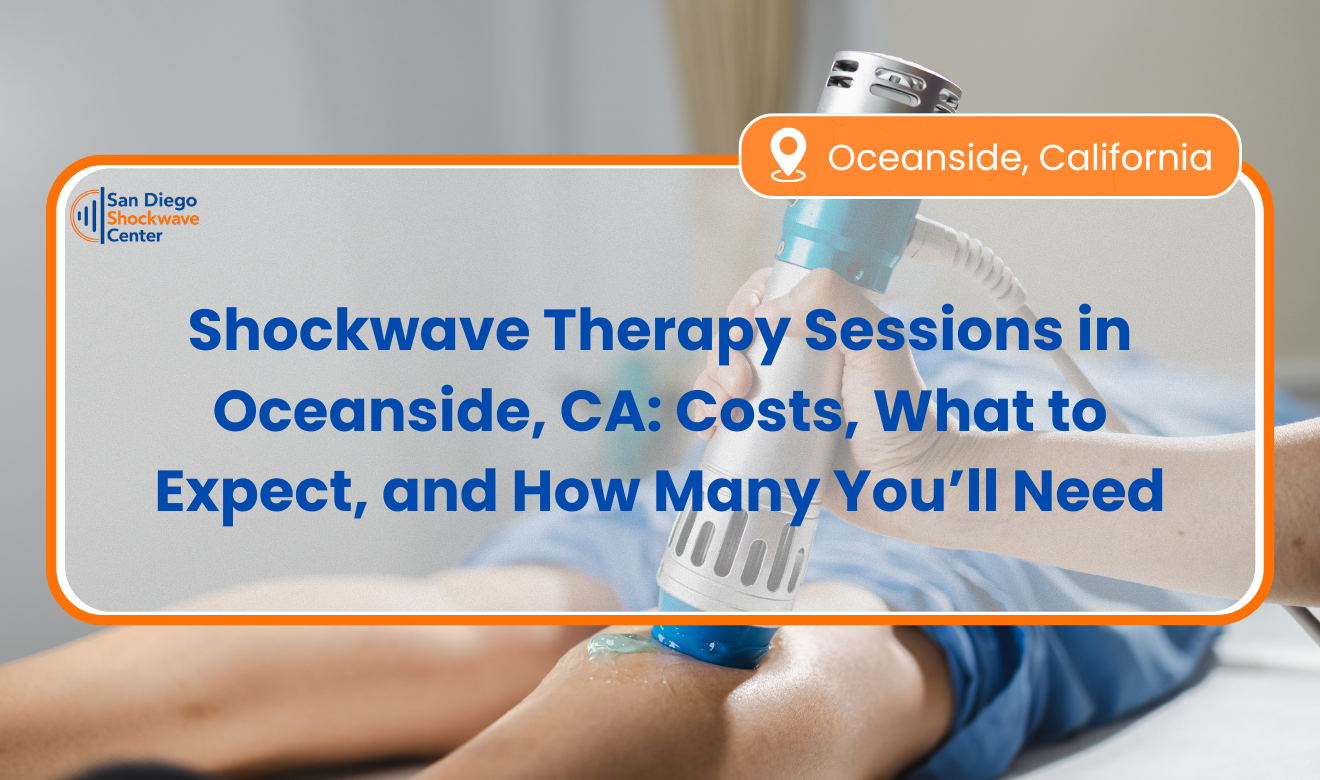
Shockwave therapy sessions Oceanside are outpatient appointments that use focused acoustic pressure waves to stimulate tissue repair and reduce pain in common tendon and soft-tissue conditions. In Oceanside, CA, clinics typically schedule these visits in 10–20 minute blocks, with the treatment area mapped by palpation and often confirmed with diagnostic ultrasound for precision on structures like the plantar fascia, Achilles insertion, patellar tendon, or lateral epicondyle. Costs in the Oceanside market most often fall into per-session self-pay ranges, with pricing influenced by whether the provider uses focused vs radial wave delivery, whether imaging guidance is included, and whether the visit bundles an exam, home exercise programming, or follow-up reassessment. A standard plan is commonly 3–6 sessions spaced about 5–10 days apart, with progress tracked by pain scores, morning stiffness minutes, and functional tests like single-leg heel raises for Achilles issues or a step-down test for patellar tendinopathy. You can expect brief soreness, redness, or a deep ache for 24–48 hours, plus clear post-visit rules such as avoiding NSAIDs, limiting high-impact running, and keeping activity to pain-guided loading like walking the Strand or controlled calf strengthening on flat ground. This guide breaks down local cost variables, what a typical Oceanside session looks like minute-by-minute, and how clinicians decide when you need three visits versus a longer series based on diagnosis, symptom duration, and objective response.
What “Shockwave Therapy” Means in an Oceanside Clinic Setting
Shockwave treatment uses externally delivered acoustic pressure waves to stimulate local biological responses in painful tendon and fascia tissue. In Oceanside outpatient settings, it is typically performed as a cash-pay musculoskeletal procedure delivered either as focused ESWT or radial pressure wave therapy, selected based on tissue depth and clinical target.
Clinically, the goal is not “breaking up” tissue; it’s triggering mechanotransduction—cellular signaling changes in tendon, fascia, and adjacent bone–tendon interfaces—followed by improved pain modulation and progressive capacity to load. For background on the modality itself, see extracorporeal shock wave therapy (ESWT): https://en.wikipedia.org/wiki/Extracorporeal_shockwave_therapy.
- Focused ESWT: concentrates energy at a set depth; commonly selected for deeper or more insertional targets.
- Radial pressure wave: disperses energy more superficially; often used for broader pain patterns or shallower structures.
- Delivery is “dose-based”: clinicians adjust intensity, frequency, and number of pulses to fit diagnosis and tolerance.
Who Typically Schedules Sessions (and Who Should Not)
Most Oceanside patients booking shockwave visits have chronic tendon or fascia pain that has not improved with activity modification, footwear changes, or a structured strengthening plan. Screening is essential because certain medical conditions and medications change risk, and the treatment is not appropriate for every pain source.
Common conditions treated in local orthopedic, sports medicine, chiropractic, and physical therapy-style cash clinics include plantar fasciopathy, Achilles tendinopathy, lateral epicondylalgia (tennis elbow), patellar tendinopathy, and select shoulder tendinopathies.
- Typical fit: symptoms lasting > 6–12 weeks, localized tendon/fascia pain, predictable pain with loading, and limited response to progressive exercise alone.
- Not a fit for “red flags”: suspected fracture, infection, tumor, systemic inflammatory flare, or unexplained neurologic deficit.
- Medication review matters: anticoagulants/bleeding risk and recent corticosteroid injection history should be discussed before treatment.
For a clear, patient-facing risk and screening overview, reference this safety guide: shockwave therapy safety guide.
What a Typical Oceanside Session Looks Like (Minute-by-Minute)
Most visits are brief, structured, and reproducible: confirm the target, deliver a measured pulse dose, then provide loading rules for the next 48 hours. Oceanside clinics commonly schedule 10–20 minutes of table time, with longer blocks when diagnostic ultrasound or a formal reassessment is included.
- Check-in + clinical update (1–3 minutes): pain score, morning stiffness minutes, aggravating loads since last visit.
- Target mapping (2–5 minutes): palpation to locate maximal tenderness; many clinics confirm with ultrasound for tendon thickness, neovascularity patterns, or enthesis location.
- Dose setup (1–2 minutes): gel applied; applicator position chosen to align with tendon fibers/enthesis.
- Wave delivery (5–10 minutes): pulses delivered in sets; intensity titrated to “strong but tolerable.”
- Post-visit rules (2–5 minutes): activity guidance, what soreness is normal, what to avoid, and the next appointment interval.
- Common immediate reactions: tenderness, deep ache, redness, or mild swelling that resolves within 24–48 hours.
- What clinicians track: pain with a specific task (first steps, hopping, gripping), stiffness duration, and a repeatable functional test.
Cost Variables in the Oceanside Market (What Actually Changes the Price)
Pricing differences are usually driven by the device type and what is bundled with the session (evaluation, ultrasound guidance, and follow-up metrics). Because many ESWT services are cash-pay, clinics in North County typically publish per-session pricing or package pricing and specify what is included.
When you compare options, focus less on “cheap per visit” and more on whether the plan includes proper diagnosis, measurable reassessment, and a loading program—because those pieces determine whether you need three sessions or six.
- Technology: focused ESWT devices typically carry higher overhead than radial systems.
- Imaging: ultrasound confirmation may be billed or bundled depending on provider type and clinic structure.
- Visit content: a session that includes an exam + progressive exercise plan often costs more than “waves only.”
- Case complexity: multi-site pain (e.g., plantar fascia + Achilles) can require additional mapping time and modified dosing.
If you want a deeper breakdown of typical pricing logic and how to evaluate value, see: shockwave therapy cost.
Planned Series: Why 3–6 Visits Is Common (and When It’s Longer)
Most treatment plans use a short series because tendon and fascia tissue adaptation occurs over weeks, not days, and shockwave is typically paired with progressive loading. The most common scheduling pattern is a session every 5–10 days, then reassess after the third visit to decide whether to continue.
Clinicians usually extend beyond three sessions when symptoms are long-standing, the diagnosis is insertional (bone–tendon junction), or the patient cannot yet tolerate sufficient strengthening volume.
- Often 3 sessions: symptoms under ~6 months, localized pain, rapid improvement in morning stiffness and function after the first two treatments.
- Often 4–6 sessions: symptoms over ~6–12 months, insertional Achilles pain, thicker plantar fascia on imaging, or high training demands (runners, tactical, court sports).
- Beyond 6 sessions (select cases): multi-factor cases with biomechanical overload, significant deconditioning, or inconsistent home loading compliance.
For a specific framework used by many clinics to decide the number of sessions, review: how many shockwave sessions.
Post-Session Rules That Affect Outcomes (NSAIDs, Running, and Loading)
Recovery instructions are not optional—they are part of the treatment dose because the goal is controlled tissue remodeling rather than masking pain. Oceanside providers typically emphasize pain-guided loading, avoiding unnecessary inflammation suppression, and temporarily reducing impact volume.
Many clinics advise avoiding non-steroidal anti-inflammatory drugs around treatment because they can blunt the inflammatory phase that contributes to remodeling; medication decisions should still be individualized with your prescribing clinician.
- Common 24–48 hour guidance:
- Avoid high-impact running/jumping if it spikes pain.
- Prefer walking on flat ground and controlled strength work.
- Use ice or acetaminophen only if approved and needed for comfort (follow your clinician’s advice).
- What “pain-guided” usually means: discomfort is acceptable during rehab if it settles back to baseline within 24 hours and does not progressively worsen.
- Training modifications Oceanside patients commonly use: reduce hill work, avoid speed sessions, swap to bike/elliptical temporarily, and keep beach runs limited if they increase calf/Achilles load.
For practical aftercare principles that clinics commonly align with, see: shockwave therapy recovery basics.
Condition-Specific Targeting Used in Oceanside (Plantar Fascia, Achilles, Elbow, Knee, Shoulder)
Clinicians adjust target selection and dosing based on anatomy: fascia behaves differently than tendon, and insertional pain behaves differently than mid-portion pain. In Oceanside, the most common targets include the plantar fascia origin at the medial calcaneal tubercle, Achilles insertion or mid-portion, patellar tendon (often proximal), and the common extensor tendon at the lateral epicondyle.
Because the best outcomes typically combine waves + progressive strengthening, many clinics pair treatment with a simple “minimum effective dose” home program.
- Plantar heel pain: mapping includes medial calcaneal origin and adjacent fascia bands; reassess with first-step pain and standing tolerance.
- Achilles tendinopathy: differentiate insertional vs mid-portion; reassess with single-leg heel raise capacity and stiffness on waking.
- Tennis elbow: target common extensor tendon; reassess with pain-free grip and resisted wrist extension tolerance.
- Patellar tendon pain: often proximal tendon; reassess with step-down, squat tolerance, or hopping (when appropriate).
- Shoulder tendinopathy: selection depends on whether pain is rotator cuff tendon, biceps tendon, or calcific focus; reassess with reaching and controlled overhead strength.
If your primary complaint is heel pain, start here for a condition-specific overview: Shockwave Therapy for Plantar Fasciitis.
Clinical Metrics That Determine Whether Treatment Is Working
Oceanside providers typically rely on repeatable measurements rather than “it feels a bit better” to decide whether to continue. The most useful metrics are consistent: pain during a standardized task, morning stiffness duration, and a simple functional capacity measure.
Improvement is often nonlinear; many patients notice meaningful change after 2–4 weeks as loading tolerance increases.
- Track at home:
- Morning stiffness (minutes).
- Worst pain in the last 24 hours (0–10).
- Specific task score (first steps, stairs, grip, heel raises).
- Clinic re-check examples:
- Achilles: single-leg heel raises to fatigue, pain response next day.
- Patellar tendon: step-down quality + symptom response.
- Elbow: dynamometer grip (if available) or timed hold tests.
- Decision point: if there is no measurable improvement by the third visit, clinicians often re-check diagnosis, modify loading, or refer for additional imaging/workup.
Core Specifications Table (What to Compare When Booking in Oceanside)
This table consolidates the practical “booking-level” specs that affect your experience: device type, visit length, spacing, and aftercare rules. Use it to compare clinics on what is included, not just the per-visit fee.
| Feature / Metric | Specifications | Local Guidelines |
|---|---|---|
| Session length | Commonly scheduled in 10–20 minute treatment blocks; longer if evaluation or ultrasound is added | Ask whether the appointment includes reassessment metrics and home program updates, not just wave delivery |
| Technology type | Focused ESWT (depth-specific energy) or radial pressure wave (broader, superficial dispersion) | Confirm which system is used for your diagnosis (e.g., insertional Achilles vs broader calf/fascia pain) |
| Target confirmation | Palpation-based mapping; some clinics add diagnostic ultrasound confirmation | If your pain source is unclear or multi-site, consider a provider who can image and re-check the diagnosis |
| Typical plan length | Often 3–6 sessions total | Reassess after session 3 using objective measures to decide whether to extend the series |
| Spacing | Commonly every 5–10 days | Avoid stacking appointments too close together; tissue response and load progression are week-to-week |
| Aftercare constraints | Brief soreness 24–48 hours is common; many clinics limit high-impact activity short-term | Follow pain-guided loading rules and clarify NSAID guidance based on your medical history |
How Clinicians Decide Between “Waves Only” vs Waves + Rehab
Shockwave works best when it is paired with a structured loading plan that progressively strengthens the involved tendon or fascia. Clinics that integrate rehab can often make faster, clearer decisions about whether to continue treatment because load tolerance is measured.
If you are comparing options in Oceanside, ask directly what exercise programming is included and how it will be progressed between visits.
- Waves-only visit advantages: quick, simple, may be appropriate when you already have a solid tendon-loading program.
- Waves + rehab advantages: better control of return-to-run/return-to-sport, clearer functional testing, fewer “guesswork” decisions.
- Best-practice integration: shockwave reduces pain sensitivity and supports tissue change; loading restores capacity and reduces recurrence risk.
For a practical comparison of where shockwave fits relative to exercise-based care, review: shockwave vs physical therapy.
Oceanside Booking Checklist (What to Ask Before You Pay)
A short checklist prevents mismatched expectations and improves your odds of completing the right number of sessions. The most important items are diagnosis clarity, dosing plan, reassessment method, and post-visit rules.
- Diagnosis: “What structure are you treating—mid-portion tendon, insertion, fascia origin, or bursa?”
- Technology: “Is this focused ESWT or radial pressure wave?”
- Plan: “How many visits do you recommend before reassessment, and what would make you stop or change the plan?”
- Metrics: “Which functional test will we repeat each visit?”
- Aftercare: “What are your NSAID, running, and strengthening rules for the first 48 hours?”
- Billing clarity: “Is the evaluation, ultrasound confirmation, and home program included in the per-session rate?”
Getting the Best Result From Your Series in Oceanside
High-quality outcomes come from matching the correct tissue target with the correct dose and then applying consistent, progressive loading between visits. When patients treat sessions like a one-time fix and keep the same aggravating training load, results are slower and less predictable.
Plan around your schedule so you can complete the series with consistent spacing and adhere to the short-term activity rules (especially if you run the Strand, play court sports, or do high-volume hill work).
- Do: keep notes on stiffness minutes, keep strengthening consistent, and report next-day flare patterns.
- Avoid: testing max effort sprints/jumps within 24–48 hours if that reliably spikes symptoms.
- Expect: gradual improvements in morning pain and load tolerance over weeks, not necessarily immediate pain elimination.
Oceanside Takeaway: A Practical Standard for High-Value Sessions
The best shockwave therapy sessions in Oceanside are defined by measurable reassessment, correct targeting (often with ultrasound confirmation), and a clear loading plan—not by the shortest appointment or the lowest sticker price. If your provider can show objective improvement by the third visit (pain, stiffness, and function), you have a strong basis for completing or shortening the series with confidence.
Use the checklist and comparison table above to select a clinic model that matches your condition (plantar fascia, Achilles, elbow, knee, or shoulder), your training demands, and your tolerance for short-term soreness—then commit to the spacing and post-visit rules that make the treatment dose actually work.
Frequently Asked Questions
Stop Guessing at Your Tendon Pain—Get a Precise Shockwave Plan in Oceanside
If you’ve been bouncing between rest, random stretching, new shoes, and “see how it feels” workouts, you’re not just losing time—you’re risking a longer, more stubborn injury. Chronic plantar fascia and tendon pain rarely improves with guesswork because the outcome depends on the right target (mid-portion vs insertion vs fascia origin), the right dose (focused vs radial, pulses, intensity, frequency), and the right loading plan between visits.
Here’s the real operational risk of trying to DIY this: when people self-manage, they often load too much too soon (flare for days, then back to zero), or they under-load for weeks (pain settles temporarily, but capacity never returns). Add in common mistakes like taking NSAIDs at the wrong time, stacking sessions too close together, or treating the wrong structure entirely, and you can turn a fixable issue into months of stop-and-start frustration—or even compensation injuries up the chain (calf, knee, hip).
Instead, get a plan that’s built to win: accurate mapping (often with ultrasound confirmation), measurable progress checks (pain, stiffness, function), and clear rules for the 48 hours after each visit so your tissue actually adapts. Book with a local team that treats this every day and can tell you—based on your response—whether you’re a 3-session case or you truly need a longer series.