
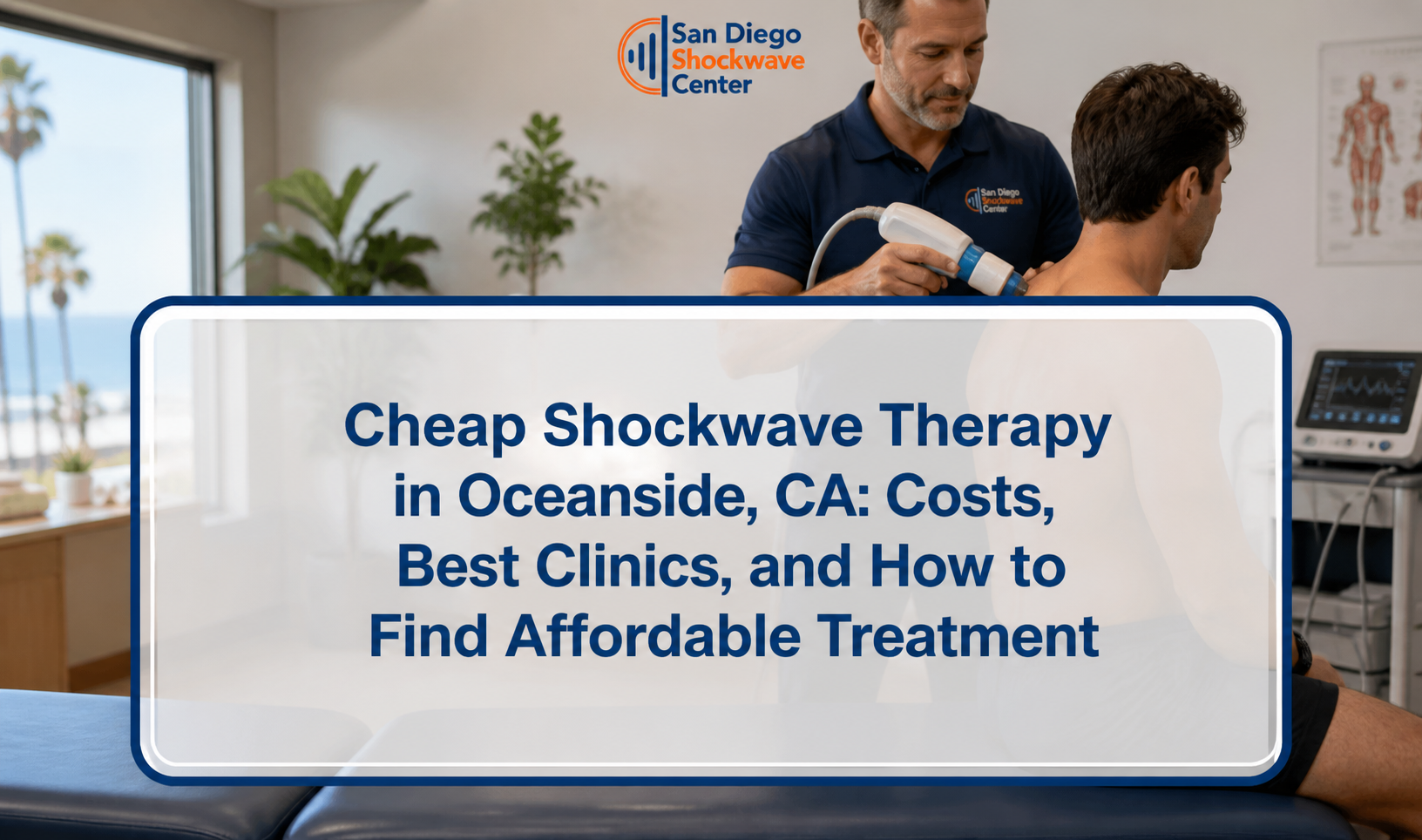
Cheap shockwave therapy in Oceanside only counts as “cheap” when the total course-of-care cost is transparent and the treatment plan is clinically appropriate for your diagnosis, typically 3–6 sessions spaced about 5–10 days apart. The best value comes from clinics that disclose device type, document session parameters, screen contraindications, and track outcomes—so you don’t pay for padded plans or hidden add-ons.
- Total Plan Cost Is the Real Price: Compare clinics using a written, all-in quote that includes evaluation, per-session fees, required rechecks, and any add-ons rather than relying on an introductory rate.
- Protocol Fit Prevents Wasted Sessions: Value depends on correct diagnosis and targeting (e.g., plantar fascia insertion) with documented pulses/settings and a finite plan aligned to your condition’s chronicity.
- Safety + Tracking Protect Your Budget: Licensed-provider delivery, contraindications screening, and measurable progress checks (pain plus function) reduce flare-ups, avoid unnecessary extra visits, and confirm whether ESWT is working.
Cheap shockwave therapy Oceanside is low-cost extracorporeal shockwave therapy (ESWT) delivered by licensed local providers at transparent, per-session pricing with clinically appropriate treatment plans. In Oceanside, CA, ESWT is commonly used for plantar fasciitis, Achilles tendinopathy, tennis elbow, calcific shoulder tendinitis, and patellar tendinopathy. Typical scheduling involves 3–6 sessions spaced about 5–10 days apart, with each visit lasting roughly 10–20 minutes of active treatment time. A practical way to judge “cheap” locally is cost per session plus total plan cost, not the advertised intro rate. Example: a plantar fasciitis protocol might target the medial calcaneal tubercle and plantar fascia band, with 1,500–3,000 pulses per session and gradually increased energy settings based on tolerance and response. Oceanside patients can also compare office-fee structures, such as evaluation charges, bundled packages, cash-pay rates, and whether follow-up rechecks are included. For affordability, many local clinics offer discounts for prepaid multi-visit plans, off-peak appointment pricing, or cash/self-pay rates that avoid extra billing layers. This guide breaks down realistic Oceanside-area costs, what “best clinic” metrics look like for ESWT, and how to screen for safe, budget-friendly treatment using provider credentials, device type, documented protocols, and clear outcome tracking.
What ESWT Is—and What “Budget-Friendly” Should Mean in Oceanside
Extracorporeal shockwave therapy is a noninvasive procedure that uses acoustic energy pulses to stimulate tissue remodeling and pain reduction in tendons, fascia, and some calcifications. In Oceanside, affordability should be measured by total course-of-care cost plus clinical appropriateness, not teaser pricing.
ESWT is widely described as using focused or radial acoustic waves applied through a handheld applicator with coupling gel; the energy is delivered to a targeted region using a protocol that balances efficacy and tolerance. A reliable reference overview of the modality is available in the general description of extracorporeal shockwave therapy.
- Budget-friendly = transparent per-session pricing + no surprise add-ons + a plan length matched to diagnosis and chronicity.
- Not budget-friendly = low “intro” rate that requires extra billed rechecks, mandatory add-on modalities, or unusually long plans without documented need.
- Local reality: most Oceanside-area ESWT plans cluster around 3–6 visits for common tendinopathies when conservative care has stalled.
Conditions Commonly Treated in North County With Shockwave
ESWT is most often used locally for chronic soft-tissue pain syndromes with degenerative tendon or fascia changes. Matching the diagnosis to the correct anatomical target is the main determinant of value and outcomes.
In a cost-sensitive plan, the provider should specify the working diagnosis, the target tissue, and the objective findings (exam, imaging if applicable) that justify ESWT rather than generic “heel pain” or “elbow pain” billing language.
- Plantar fasciitis: medial calcaneal tubercle insertion and plantar fascia band tenderness; morning start-up pain is common.
- Achilles tendinopathy: mid-portion Achilles vs insertional Achilles require different tolerance and targeting strategies.
- Lateral epicondylitis (tennis elbow): extensor carpi radialis brevis tendon origin; grip pain and resisted wrist extension pain.
- Calcific shoulder tendinitis: pain with overhead motion; calcification may be seen on imaging when present.
- Patellar tendinopathy: inferior pole patella tendon pain, often with jumping/landing loads.
If your primary complaint is persistent anterior knee pain, a relevant clinical reference is shockwave therapy for knee pain, which outlines typical use cases and practical expectations.
Realistic Session Structure: What You Should Expect to Happen Each Visit
Most Oceanside ESWT appointments are short and protocol-driven, with active treatment commonly lasting 10–20 minutes. A “cheap” plan stays affordable by staying efficient while still documenting targets, settings, and progression.
A standard visit should include an abbreviated symptom check, localization of the most tender/affected tissue, delivery of pulses at prescribed settings, and a short aftercare plan. Patients should be told what post-treatment soreness is normal and what red flags require contact.
- Pre-check (1–3 minutes): pain score, activity changes, medication changes, contraindications screening.
- Localization (1–3 minutes): palpation and functional provocation; ultrasound guidance may be used by some clinicians depending on training and equipment.
- Delivery (10–20 minutes active time): pulses delivered to the target tissue; settings adjusted based on tolerance and response.
- Post-visit instructions (1–3 minutes): relative rest guidance, load management, and what to avoid for 24–48 hours.
- Typical spacing: 5–10 days between sessions to allow biological response and symptom tracking.
- Typical course length: 3–6 sessions for many chronic cases; fewer sessions may be reasonable for mild presentations.
Transparent Pricing: The Only “Cheap” Metric That Matters Is Total Plan Cost
Cost comparisons should be built from all required charges across the full course, including evaluation, imaging review (if billed), session fees, and rechecks. The lowest advertised per-session rate can still be more expensive if the plan is padded or loaded with separate office fees.
Because clinics structure fees differently, the cleanest way to compare Oceanside options is to request a written quote that includes every line item expected over the recommended number of visits.
- Ask for the all-in total: “If I complete the recommended plan, what will I pay in total?”
- Confirm what’s included:
- Initial evaluation and diagnosis
- Number of ESWT sessions recommended
- Follow-up rechecks and progress measures
- Any required add-ons (bracing, orthotics, ultrasound, manual therapy)
- Clarify payment pathway: cash/self-pay rate vs insurance-billed evaluation plus self-pay ESWT (a common split model).
Data Table: Cost, Protocol, and Clinic-Quality Metrics to Compare in Oceanside
This table consolidates the most decision-relevant metrics that determine both affordability and safety. Use it to compare clinics using objective, checkable criteria rather than marketing terms.
When you request pricing and plan details, you should be able to fill in every row with a clear “yes/no” or a specific number.
| Feature / Metric | Specifications | Local Guidelines |
|---|---|---|
| Written total-cost quote | Single document listing eval fees, per-session fees, number of sessions, and recheck charges | Request before starting; compare using total plan cost, not intro rates |
| Number of sessions + spacing | Typical scheduling is 3–6 sessions spaced ~5–10 days apart | Plans should match diagnosis and chronicity; avoid open-ended “weekly indefinitely” plans |
| Device type disclosed | Clinic identifies whether system is radial pressure wave or focused shockwave | Ask for device modality and why it fits your condition (e.g., superficial vs deeper targets) |
| Documented protocol parameters | Pulses per session, target region, and progression plan noted in chart | For plantar fascia, many protocols use ~1,500–3,000 pulses/session with graded intensity by tolerance |
| Outcome tracking method | Pain scale plus function metric (e.g., walking tolerance, hop test, grip strength proxy) | Should be recorded at baseline and at defined milestones (e.g., session 1, 3, final, and follow-up) |
| Contraindications screening | Bleeding disorder/anticoagulants review, pregnancy status, cancer in treatment area, infection, open wounds | Clinic should screen and document before first treatment and update if meds change |
How to Screen a Provider for Legal, Safe Treatment in California
In California, ESWT should be delivered by, or under the legally appropriate supervision of, a licensed healthcare professional working within their scope of practice. You can verify most licenses through the State of California’s public license lookup systems.
To protect both safety and cost, confirm that the clinician who performs ESWT is appropriately credentialed and that the clinic has a written intake process that screens for contraindications and documents your diagnosis.
- Common provider types in Oceanside:
- Physical therapists (PT)
- Chiropractors (DC)
- Podiatrists (DPM)
- Medical doctors (MD/DO) in sports medicine/orthopedics/pain medicine
- What to ask directly:
- “Who will perform the treatment, and what is their license?”
- “How do you screen contraindications and medication risks?”
- “Will you document settings, pulses, and targets each visit?”
- What to verify yourself: active license status and any public disciplinary actions via California’s online license verification portals (profession-specific).
What Makes One Clinic “Best” for Value: Protocol Fit + Tracking + No Hidden Fees
The best value clinic is the one that uses the right device approach for your condition, applies a documented protocol, and tracks outcomes while keeping pricing predictable. A lower per-session price is not a savings if the plan is longer than medically justified or poorly targeted.
High-quality ESWT care also includes load management guidance (activity modification and progressive strengthening) because shockwave is not a stand-alone fix for most tendinopathies.
- Value signals:
- Clear diagnosis and target tissue mapping
- Session count justified by chronicity and response checkpoints
- Transparent pricing and written totals
- Functional milestones (not just “pain feels better”) documented
- Red flags:
- “One size fits all” settings for every body part
- No screening for anticoagulants or local infection
- Pressure to buy large packages before any evaluation
- No progression plan or home-loading guidance
Ways Oceanside Patients Can Lower Out-of-Pocket Cost Without Cutting Safety
Legitimate cost reductions come from simplified billing, prepaid multi-visit discounts, and removing unnecessary add-ons—not from skipping evaluation or compressing sessions into unsafe frequency. You can keep the plan affordable while still requiring proper screening and documentation.
When you negotiate price, negotiate structure: ask what fees can be bundled and what follow-ups are included.
- Cost-lowering options that are commonly offered:
- Cash/self-pay rates (often lower than billed charges)
- Prepaid multi-visit pricing (ensure refund policy is clear)
- Off-peak appointment discounts (midday slots)
- Bundled evaluation + first session packages (only if diagnosis is still properly documented)
- Cost traps to avoid:
- Mandatory memberships that add monthly fees
- Session fees that exclude “required” rechecks
- Separate charges for routine items (gel, “device fee,” “setup fee”) without prior disclosure
Condition-Specific Targeting Notes (So You Pay for the Right Treatment)
Condition-specific targeting ensures the energy is delivered where it is most likely to help, which prevents wasted sessions. The clinic should be able to explain the anatomical target and the functional test that reproduces your symptoms.
If you want a deeper clinical overview of a common use case, see Shockwave Therapy for Plantar Fasciitis for how protocols are typically structured around the plantar fascia insertion and symptom response.
- Plantar fascia pain:
- Target: medial calcaneal tubercle insertion + proximal fascia band
- Session structure: commonly ~1,500–3,000 pulses with graded energy increases as tolerated
- Value check: provider should retest first-step pain and walking tolerance over the course
- Achilles tendinopathy:
- Target: mid-portion tendon vs insertional region (different irritability)
- Value check: progressive calf loading plan is explained and monitored
- Tennis elbow:
- Target: common extensor tendon origin
- Value check: grip pain and resisted wrist extension should be reassessed at milestones
- Shoulder calcific tendinitis:
- Target: area consistent with imaging and exam; aim is reducing pain and improving function
- Value check: range of motion and night pain tracked, not just “tenderness”
- Patellar tendinopathy:
- Target: patellar tendon near inferior patellar pole
- Value check: symptom response to squats/step-downs/jumping loads tracked over time
Aftercare and Activity Rules That Prevent Paying for Setbacks
Most unnecessary extra sessions come from preventable flare-ups due to poor load management after treatment. A cost-effective plan includes clear, written aftercare guidelines so you don’t undo progress between visits.
While protocols vary by diagnosis, most clinics use a conservative 24–48 hour window of relative rest from high-impact or high-load activities, then a gradual return aligned to symptom response.
- Common short-term guidance:
- Avoid maximal-impact activity for 24–48 hours unless your clinician advises otherwise
- Use pain as a limiter; mild soreness can be normal, sharp worsening pain is not
- Follow the prescribed strengthening/loading plan (often the main driver of long-term tendon change)
- Trackable markers that reduce wasted visits:
- Morning pain score (plantar fascia)
- Walking or running tolerance time
- Single-leg calf raise tolerance (Achilles)
- Grip tolerance (tennis elbow proxy)
Smart Takeaway: How to Get Oceanside ESWT That’s Affordable, Safe, and Actually Works
The most affordable shockwave plan is the one with a documented diagnosis, a finite evidence-aligned session count, and upfront total pricing that includes all required visits and rechecks. When Oceanside patients compare clinics using total plan cost, device type disclosure, protocol documentation, and outcome tracking, they avoid paying for poorly targeted or needlessly extended care.
Before you book, insist on three concrete items: (1) a written total quote for the recommended number of sessions, (2) confirmation of the treating clinician’s license and contraindication screening process, and (3) a measurable progress plan (pain plus function) reviewed at defined milestones. That combination is what reliably separates truly low-cost ESWT from “cheap” advertising that becomes expensive later.
Frequently Asked Questions
Stop Overpaying for “Cheap” Shockwave Therapy in Oceanside—Get a Clear Plan That Actually Works
Here’s the truth about “budget” ESWT in Oceanside: the wrong clinic can turn a low intro price into an expensive, drawn-out mess. And it usually happens the same way—vague diagnosis, cookie-cutter settings, padded treatment plans, surprise add-on fees, and zero objective tracking to prove it’s helping.
When shockwave is done without a clear protocol and proper screening, you’re not just risking your wallet—you’re risking wasted weeks of pain, unnecessary flare-ups that force extra sessions, and missed red flags (like medication risks, infection concerns, or the wrong tissue being treated entirely). Even worse, poorly targeted treatment can make you think “shockwave doesn’t work,” when the real problem was the plan—not the technology.
If you want ESWT that’s truly affordable, it has to be efficient and clinically appropriate: the right diagnosis, the right target, the right device approach, documented session parameters, and a finite plan with measurable milestones. That’s how you avoid paying for guesswork.
Book with a local team that can quote your total plan cost upfront, explain exactly what they’re treating and why, and track progress so you’re not stuck in an endless cycle of “maybe one more session.”