
Executive Summary
Radial shockwave therapy is presented as a non-invasive, clinic-based treatment that can reduce chronic tendon and fascia pain and improve function—especially when standard approaches (rest, stretching, basic therapy) haven’t worked. The article emphasizes that outcomes are strongest when shockwave is paired with progressive strengthening, load management, and clear reassessment.
Key Takeaways
- Non-invasive pain relief for stubborn overuse injuries: Radial shockwave is highlighted as a surgery-free option commonly used to decrease pain and improve day-to-day capacity in chronic tendon and fascia conditions.
- Radial vs. focused shockwave matters: Radial shockwave disperses energy more broadly and is typically used for more superficial tendon/fascia issues, while focused shockwave targets deeper tissue.
- Best-fit conditions are predictable: The most common uses include plantar heel pain/plantar fasciitis, tennis elbow, Achilles tendinopathy, and patellar tendinopathy—often when symptoms persist for months.
- Results depend on combining treatment with rehab: The article’s central point is that shockwave helps reduce sensitivity so patients can tolerate progressive loading programs that drive durable recovery.
- Expect a short series and gradual improvement: Many clinics use weekly sessions with reassessment; some patients notice early changes in 1–2 visits, while meaningful gains typically build over weeks and can continue after treatment ends.
Radial shockwave therapy can help reduce pain, improve mobility, and speed up recovery from common overuse injuries, often without surgery or long downtime. If you’re searching for radial shockwave therapy benefits San Diego, this treatment is frequently used for stubborn issues like plantar fasciitis (heel pain that flares up with your first steps), tennis elbow (pain when gripping a mug or turning a doorknob), and Achilles tendinopathy (tight, sore tendon after runs). Many people notice they can walk longer, return to workouts sooner, or get through a workday with less discomfort after a series of sessions. It’s a non-invasive option that targets the irritated tissue directly, which can be especially helpful when rest, stretching, or standard therapies haven’t been enough.
What radial shockwave therapy is (and how it’s different from “focused” shockwave)
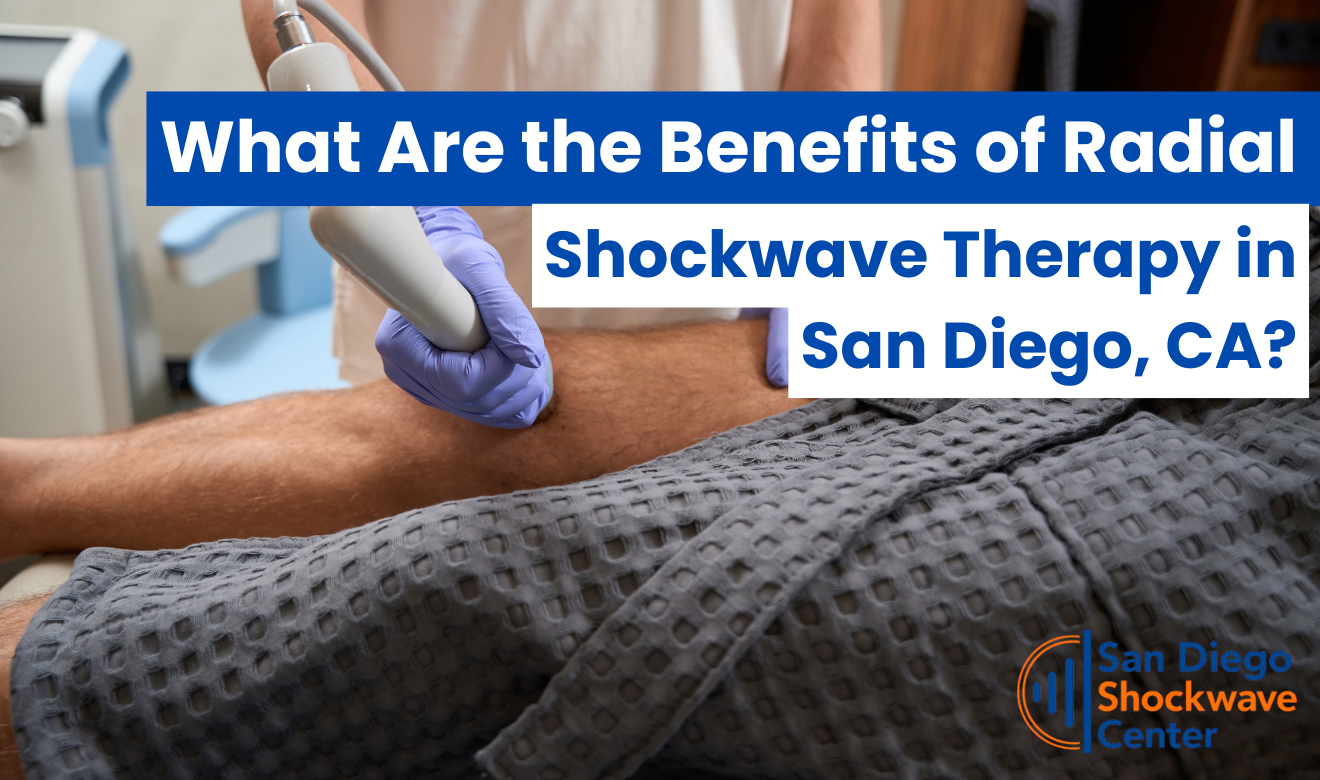
Radial shockwave therapy uses pressure waves delivered through a handheld applicator to the surface of the skin. The energy spreads out (“radially”) through the tissue, which makes it a common choice for broad, stubborn pain areas—especially overuse injuries involving tendons and fascia.
If you’re researching radial shockwave therapy benefits San Diego, it helps to know the basic categories:
- Radial shockwave: disperses energy over a wider area; often used for tendon and fascia pain near the surface.
- Focused shockwave: concentrates energy deeper into tissue; sometimes used for deeper targets.
Both fall under the umbrella of extracorporeal shockwave therapy (ESWT). For background on ESWT as a modality, see extracorporeal shockwave therapy.
How radial shockwave therapy works for stubborn tendon and fascia pain
Most overuse injuries aren’t “fresh injuries.” They’re often a cycle of irritated tissue, sensitized pain pathways, and reduced load tolerance. Radial shockwave therapy aims to interrupt that cycle by delivering mechanical pulses that can stimulate tissue-level responses over time.
Commonly discussed mechanisms include:
- Pain modulation: may help desensitize irritated nerves and reduce pain signaling.
- Improved local circulation: pressure waves may increase microcirculation in the treated region.
- Cellular signaling: research describes changes in growth-factor signaling and tissue remodeling responses after shockwave exposure.
- Breaking up chronic “stuck” patterns: especially when combined with progressive strengthening and load management.
These effects are why radial shockwave therapy benefits San Diego searches are so common among runners, hikers, pickleball players, and people who stand all day for work.
What conditions it’s most used for in San Diego
Clinically, radial shockwave therapy is most often used for common tendinopathies and fascia-related pain patterns that don’t respond well to rest alone. If you’re weighing radial shockwave therapy benefits San Diego, these are the “usual suspects” people seek help for:
Plantar fasciitis / plantar heel pain
- Sharp heel pain with first steps in the morning
- Pain after long walks or standing
- Often lingers for months without the right loading plan
Tennis elbow (lateral epicondylalgia)
- Pain when gripping, lifting, shaking hands, or turning a doorknob
- Often stubborn because daily use keeps re-irritating the tendon
Achilles tendinopathy
- Stiffness and pain after runs or the day after activity
- Sometimes thickened tendon or soreness at the insertion
Patellar tendinopathy (“jumper’s knee”)
- Front-of-knee pain with jumping, stairs, squats, or running
If knee pain is your primary issue, you may also want to read shockwave therapy for knee pain to see how clinicians typically combine sessions with rehab.
Why people choose radial shockwave therapy instead of “waiting it out”
For many overuse injuries, time helps—until it doesn’t. People often start looking up radial shockwave therapy benefits San Diego when symptoms keep returning despite stretching, icing, massage, or taking a week off.
Common reasons people choose radial shockwave:
- Non-invasive: no incisions, no anesthesia, no surgical recovery timeline.
- Time-efficient: sessions are typically short and done in-office.
- Works well with rehab: pairs with progressive strengthening, mobility, and load management.
- May reduce reliance on pain meds: some people use it to help avoid repeated medication cycles.
- Targeted: treatment is directed at the painful tendon/fascia region and surrounding tissue.
What the research says (real-world stats, not hype)
Evidence varies by condition, the type of shockwave used, and how outcomes are measured, but overall research supports ESWT as a reasonable option for several chronic tendon and heel pain problems.
- Plantar heel pain: Multiple systematic reviews and clinical guidelines support ESWT as an option for chronic plantar fasciitis/plantar heel pain, particularly when conservative care fails. The American College of Foot and Ankle Surgeons (ACFAS) includes ESWT among accepted treatments for recalcitrant heel pain in its clinical guidance.
- Tendinopathies (Achilles, lateral elbow): Systematic reviews commonly report improvements in pain and function compared with placebo or some conservative approaches—especially in chronic cases and when paired with appropriate loading exercises.
- Return to activity: In sports medicine settings, shockwave is frequently used to help athletes progress sooner by reducing pain enough to tolerate strengthening and graded return-to-sport plans.
Important nuance: shockwave therapy is not a “magic reset.” The best outcomes are typically reported when treatment is integrated with an evidence-based rehab plan (progressive tendon loading, calf/foot strengthening, grip strengthening, etc.). That combination is a big part of the real radial shockwave therapy benefits San Diego patients care about—less pain, more capacity, and a path back to activity.
How many sessions people typically need (and when they feel improvement)
Protocols vary by condition, chronicity, and tolerance, but many clinics use a short series of sessions—often weekly—then reassess.
Typical patterns people report:
- Early changes: some notice reduced morning pain or improved “warm-up” tolerance after 1–2 sessions.
- Meaningful improvement: often shows up over several weeks as tissue sensitivity drops and strength work becomes easier.
- Full benefit: may continue building for weeks after the last session as remodeling and rehab progress.
If you want a deeper breakdown on timing and planning, read how many shockwave sessions.
Does radial shockwave therapy hurt?
It can be uncomfortable, but it’s usually tolerable and adjustable. Most providers start with a lower intensity, then increase as you acclimate. The sensation is often described as a rapid tapping or deep ache directly over tender tissue.
What affects comfort:
- How irritable the injury is that day
- Area treated (some spots are more sensitive)
- Intensity settings and treatment time
- Your activity level leading into the session
Because pain is a common concern among people searching radial shockwave therapy benefits San Diego, it’s worth asking your provider how they dose intensity and how they modify for sensitive areas.
Cost: what to expect in San Diego (and what drives price)
Pricing varies widely based on clinic type, clinician credentials, equipment, and whether sessions are bundled. Many cash-based practices price per session, while others offer packages.
Factors that commonly influence cost:
- Type of device (quality, maintenance, FDA clearance status for indications)
- Time included (shockwave only vs. shockwave + rehab guidance)
- Provider expertise (sports medicine, orthopedics, podiatry, physical therapy)
- Bundled plan (package discounts vs. single visits)
For a more detailed local pricing overview, see shockwave therapy cost. Understanding cost upfront helps you weigh the radial shockwave therapy benefits San Diego patients often prioritize: fewer missed workdays, improved training tolerance, and avoiding more invasive steps.
What to do before and after treatment to maximize results
Radial shockwave therapy tends to work best when your day-to-day tissue load is managed—meaning you do enough to stimulate adaptation, but not so much that you constantly flare symptoms.
Before your session
- Avoid “pain masking” if advised: some providers recommend avoiding anti-inflammatory medications around sessions (ask your clinician; do not stop prescribed meds without medical guidance).
- Arrive with context: know what activities trigger symptoms (mileage, shoes, work shifts, lifting, grip tasks).
- Be ready to move: many clinicians reassess function (single-leg heel raises, grip strength, hop tolerance, etc.).
After your session (same day)
- Expect mild soreness in the treated area (often similar to post-workout tenderness).
- Keep activity reasonable: most plans allow normal daily movement but avoid “hero workouts” for 24–48 hours, depending on irritability.
- Follow your loading plan: progress strengthening as directed (this is where long-term change happens).
A simple example progression (tendon pain)
- Week 1–2: pain-calmed isometrics + light eccentrics
- Week 2–4: heavier slow resistance + graded return to impact
- Week 4–8: sport-specific loading, plyometrics as tolerated
Many people who search radial shockwave therapy benefits San Diego are relieved to learn they usually don’t need complete rest—they need the right dose of activity.
Radial shockwave therapy vs. other options (quick comparison)
People often compare radial shockwave with injections, physical therapy, or “just stretching.” Here’s a clear way to think about it: shockwave is often used to reduce pain and improve tissue responsiveness so you can actually do the rehab that fixes the problem long-term.
| Option | What it’s best for | Common limitations |
|---|---|---|
| Radial shockwave therapy | Chronic tendon/fascia pain; reducing sensitivity to enable rehab | Usually requires multiple sessions; works best with a loading plan |
| Physical therapy (exercise-based) | Strength, mobility, movement retraining, return-to-sport planning | Pain may limit exercise tolerance early on without adjuncts |
| Corticosteroid injection (selected cases) | Short-term pain reduction for some inflammatory conditions | May not be ideal for certain tendons; benefits can be temporary; recurrence risk |
| Rest + stretching only | Acute flare calming, comfort | Often insufficient for chronic tendinopathy without progressive strengthening |
If you’re deciding between approaches, you may find it helpful to read shockwave vs physical therapy. For many cases, it’s not either/or—combining them is where the biggest radial shockwave therapy benefits San Diego patients report show up.
Mini case examples: what “success” often looks like
These are typical clinical patterns seen across sports medicine and outpatient rehab (not promises, and not a substitute for an evaluation):
Case example 1: Plantar heel pain in a standing job
- Starting point: sharp first-step pain, worse after long shifts; calf tightness; high daily step count.
- Plan: radial shockwave sessions + calf/foot strengthening + footwear/standing-break adjustments.
- Common win: reduced morning pain and improved tolerance for full workdays, then gradual return to long walks.
Case example 2: Tennis elbow from gym + desk work
- Starting point: pain gripping dumbbells, opening jars, typing with a sore forearm.
- Plan: radial shockwave + graded wrist extensor loading + grip modifications and pacing.
- Common win: better grip tolerance and less “grabby” pain during daily tasks, allowing progressive strength return.
These examples reflect why people keep searching radial shockwave therapy benefits San Diego: it’s often the missing piece that helps stubborn pain finally respond to a structured plan.
What to look for in a provider (quick checklist)
Technique, dosing, and clinical decision-making matter. To get the most real-world radial shockwave therapy benefits San Diego can offer, look for:
- Licensed medical professional (scope varies by state and discipline)
- Clear diagnosis and differential (not all heel or elbow pain is the same problem)
- Outcome tracking: pain scale plus functional measures (heel raises, hop tests, grip strength, steps tolerated)
- Integrated rehab plan: progressive strengthening and return-to-activity guidance
- Safety screening: bleeding disorders, anticoagulants, pregnancy, local infection, suspected fracture, or other red flags
For a plain-language overview of the modality itself, see what is shockwave therapy.
When you should NOT push through pain (and when to get evaluated first)
Even if you’re focused on radial shockwave therapy benefits San Diego, some symptoms need medical evaluation before any modality:
- Sudden “pop” with immediate weakness (possible tendon rupture)
- Rapid swelling, redness, fever, or warmth (possible infection or inflammatory flare)
- Numbness/tingling, radiating pain, or significant night pain
- Inability to bear weight after an injury
- History of cancer near the area of pain (needs appropriate medical guidance)
Radial shockwave is usually used for mechanical overuse pain—not undiagnosed or urgent conditions.
Back to Doing What You Love: the bottom line on results
The most consistent radial shockwave therapy benefits San Diego patients seek are practical: less daily pain, more walking tolerance, and a faster return to workouts—without surgery or long downtime. For chronic plantar heel pain, tennis elbow, Achilles tendinopathy, and similar overuse issues, radial shockwave can be a strong add-on when the problem has become stubborn.
To build trust in your plan, choose care that includes:
- Evidence-informed shockwave dosing and reassessment
- A progressive loading program (strength and capacity building)
- Clear safety screening and realistic expectations
In most reputable sports medicine and rehab settings, shockwave is delivered by clinicians with formal medical training (such as physical therapists, sports medicine physicians, orthopedic clinicians, or podiatrists) who routinely treat tendinopathy and return-to-activity cases—experience that matters when your goal is not just pain relief, but durable function.
radial shockwave therapy benefits san diego
radial shockwave therapy benefits san diego
radial shockwave therapy benefits san diego
radial shockwave therapy benefits san diego
radial shockwave therapy benefits san diego
radial shockwave therapy benefits san diego
radial shockwave therapy benefits san diego
radial shockwave therapy benefits san diego
radial shockwave therapy benefits san diego
radial shockwave therapy benefits san diego
Frequently Asked Questions
Ready to See If Radial Shockwave Is Your Missing Piece?
If you’re done guessing, stretching forever, and “waiting it out,” it may be time for a clear plan. At San Diego Shockwave Therapy Center, we help active San Diego locals tackle stubborn plantar heel pain, tennis elbow, Achilles tendinopathy, and other overuse injuries with radial shockwave therapy—paired with smart load management and rehab guidance to get you back to moving with less pain.
Want to know if you’re a good candidate? Reach out today to schedule an evaluation, get your questions answered, and map out a realistic session plan based on your symptoms, activity level, and goals.